
Financial modeling for startups follows the same core logic as financial modeling anywhere else, but here’s the thing — it’s really just a structured way of answering one question: ‘if X happens, what does that do to the money?’ Whether you’re pricing out whether to hire your next employee or building a discounted cash flow model for a company valuation, you’re doing the same fundamental exercise. This guide breaks down how financial modeling actually works, for whichever side of that question brought you here.
Want new templates emailed to you?
No spam. Unsubscribe anytime. Downloads never require this.
What Is Financial Modeling, Really?
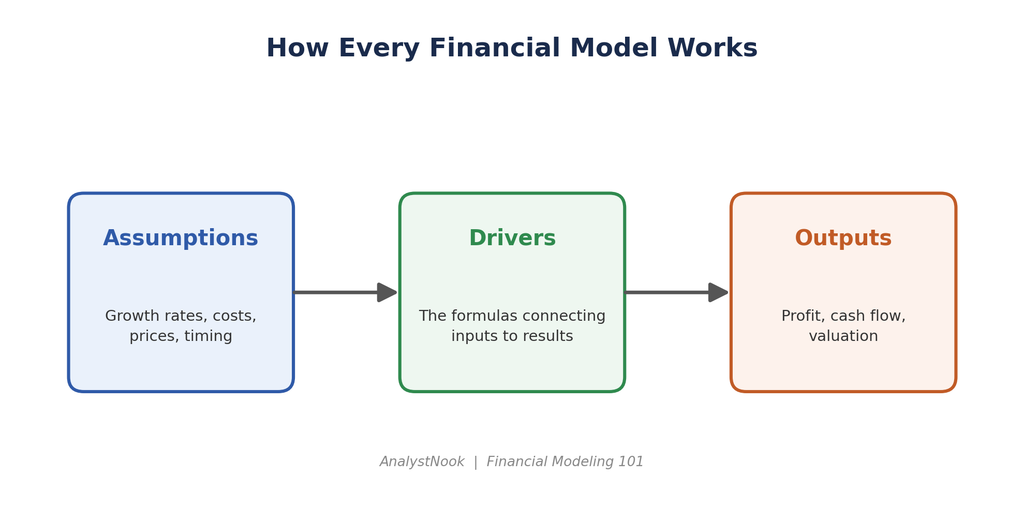
At its core, a financial model is a spreadsheet that turns assumptions into projections. You feed in inputs — things like expected revenue growth, costs, or interest rates — and the model calculates what happens to profit, cash flow, or value as a result. The complexity ranges from a simple one-tab budget to a hundred-tab leveraged buyout model, but the underlying logic never changes: inputs drive outputs, and the model is only as good as the assumptions behind it.
The Building Blocks Every Model Shares
Every financial model, no matter how simple or advanced, is built from the same core pieces. Assumptions are the inputs you control or estimate — growth rates, prices, costs, timing. Drivers are the relationships that connect those assumptions to results, like “revenue equals customers times average order value.” Outputs are what the model produces — profit, cash flow, a valuation, a break-even point. Understanding this structure means you can look at any model, no matter how unfamiliar, and figure out what’s actually driving the numbers.
For Business Owners: Why This Matters Even If You’ll Never Build a DCF
You don’t need to build a discounted cash flow model to run a healthy business, but you do need to understand the same underlying logic. If you’ve ever been surprised that a “profitable” month still left you short on cash, that’s a modeling gap — you weren’t tracking the timing difference between when revenue is earned and when cash actually arrives. A simple cash flow model, even a basic one, answers questions like: if I hire this person, how many months until I feel it in my bank balance? If I land three more clients, what actually happens to my margins? These aren’t Wall Street questions — they’re the exact questions that determine whether a small business survives its first few years.
Financial Modeling for Startups: What Investors Actually Want to See
Financial modeling for startups follows the same core logic as any other model, but investors read it differently than a lender or a corporate finance team would. They’re less interested in whether your spreadsheet is elegant and much more interested in three things: how fast you’re burning cash, how many months of runway that leaves you, and what has to go right for your projections to hold up.
That means your startup financial model should make burn rate and runway impossible to miss, not buried three tabs deep. If you haven’t built that piece yet, our burn rate and runway calculator walks through exactly how to calculate both, and drops straight into the model you’re building here.
Beyond burn and runway, investors will stress-test your assumptions: customer acquisition cost, churn, and sales cycle length. Build your model so those assumptions live in clearly labeled input cells rather than hardcoded inside formulas. It’s the fastest way to show a reader you understand your own numbers, and it’s what separates a startup model that survives due diligence from one that doesn’t.
For Aspiring Analysts: The Models You’ll Actually Be Asked to Build
If you’re aiming for a role in finance, three model types come up constantly. A DCF (discounted cash flow) model estimates what a company is worth today based on the cash it’s expected to generate in the future, discounted back to reflect the time value of money. An LBO (leveraged buyout) model examines what happens when a company is purchased using significant debt, and whether the returns justify the risk. Comps (comparable company analysis) values a business by looking at what similar companies trade for, using ratios like price-to-earnings. Later articles on this site will walk through each of these step by step, with downloadable templates so you can build them yourself rather than just reading about them.
The Three Financial Statements That Tie Everything Together
Nearly every model, regardless of purpose, connects back to three financial statements. The income statement shows revenue, expenses, and profit over a period of time. The balance sheet shows what a business owns and owes at a single point in time. The cash flow statement reconciles the two, showing where cash actually moved, which is often different from what the income statement implies because of timing and non-cash items. If you only remember one thing from this section, remember that profit and cash are not the same thing — that gap is where a lot of businesses get into trouble, and where a lot of analyst interview questions come from.
Tools You Can Use to Build a Financial Model
You don’t need expensive software to start financial modeling. Excel remains the industry standard for a reason: it’s flexible, nearly every finance professional already knows it, and it doesn’t lock your assumptions inside a black box. Google Sheets is a solid free alternative, especially useful when you need to collaborate with a co-founder or business partner in real time, though it can slow down once a model gets large and formula-heavy.
Beyond spreadsheets, a newer category of dedicated planning tools has emerged, built specifically for startups and small businesses that want cleaner dashboards and less manual formula-wrangling. These tools trade some flexibility for speed and are worth exploring once your spreadsheet model becomes difficult to maintain. But for learning the discipline of financial modeling itself, a spreadsheet is still the best place to start: you can see every formula, trace every number back to its source, and build habits that transfer to any tool later.
One more note worth adding: AI tools can now draft formulas, summarize a model’s outputs, or flag inconsistencies faster than doing it by hand. They’re genuinely useful for speeding up the mechanical parts of financial modeling. What they can’t do is decide which assumptions are reasonable for your specific business or deal, that judgment still comes from understanding the fundamentals covered in this guide.
What matters far more than the software is the structure you impose on it. Keep assumptions on their own tab, separate from calculations and outputs. Color-code inputs, the numbers you type in, differently from formulas, the numbers the model calculates, so anyone reviewing your work, including future you, can tell at a glance what’s driving the results. This convention alone will save you hours of confusion down the line.
A Simple Financial Model Example: Modeling a Coffee Shop’s First Year
Abstract explanations only go so far, so here’s a scaled-down financial modeling example you could build in twenty minutes. Say you’re opening a small coffee shop. Your assumptions might be 80 cups of coffee sold per day at an average price of $4.50, six days a week, with ingredient and cup costs eating up 30% of each sale.
Your drivers translate those assumptions into monthly numbers. Revenue is cups sold multiplied by average price multiplied by days open, roughly $8,640 a month. Cost of goods sold is 30% of that, about $2,592. Then you layer in fixed costs that don’t change with sales volume: rent, insurance, and a part-time employee’s wages, maybe $4,500 a month combined.
Your output is the bottom line: revenue minus cost of goods minus fixed costs, which in this simplified version leaves roughly $1,548 a month in profit. That single number is useful, but the real value of the model shows up when you start changing assumptions. What happens if foot traffic is 20% lower than expected in month one? What if you raise your average price by fifty cents? A good financial model lets you answer those questions in seconds instead of guessing.
This is also where financial modeling earns its keep for a small business owner: it turns a vague worry like “I hope this works out” into a specific, testable number, the exact sales volume you need to break even, and how much cushion you have if a slow month hits.
Common Mistakes That Undermine Even Good Models
The most common financial modeling mistake isn’t a formula error — it’s an unrealistic assumption dressed up in a well-formatted spreadsheet. A model that assumes 40% month-over-month growth forever will produce impressive-looking numbers that mean nothing. Other frequent issues include ignoring the timing of cash versus revenue, failing to stress-test what happens if a key assumption is wrong, and building something so complex that even the person who made it can’t explain how a number was calculated. A good model is one you can defend line by line, not one that simply looks sophisticated.
Best Practices That Separate Good Models From Great Ones
Good financial modeling habits show up in small, consistent choices rather than any single trick. Build in checks: a simple formula that flags when your balance sheet doesn’t balance, or when a percentage assumption drifts outside a reasonable range, will catch mistakes long before they reach a client or investor. Treat these checks as a permanent part of the model, not a one-time cleanup step.
Document your assumptions as you go. A cell that says “5%” means nothing six months later; a cell that says “5% based on last year’s average growth rate, per the Q3 report” tells the next person, or future you, exactly why that number exists. This habit alone separates models that get reused and trusted from models that get rebuilt from scratch every time someone asks a follow-up question.
Finally, resist the urge to build for every possible scenario before you’ve validated the basic structure. Start with a simple version of your financial model, confirm the logic holds together, and only then add complexity like multiple scenarios, sensitivity tables, or additional business lines. A simple model that works beats a complex model that no one, including its creator, fully understands.
It also helps to get a second set of eyes on any model before it drives a real decision. A colleague reviewing your financial modeling work with fresh eyes will spot circular logic, unrealistic assumptions, or broken formulas far faster than you will after staring at the same spreadsheet for hours.
Frequently Asked Questions
How long does it take to learn financial modeling?
Most people can build a basic three-statement model within a few weeks of focused practice. Getting comfortable enough to build a full DCF or LBO model from scratch typically takes a few months of hands-on repetition, since reading about financial modeling isn’t enough on its own, you have to build models yourself.
Do I need an accounting background to build financial models?
It helps, but it isn’t required. You’ll pick up the accounting concepts you need, like how the three financial statements connect and what belongs on the balance sheet versus the income statement, as you go. Plenty of successful financial modelers learned accounting alongside modeling rather than before it.
What’s the difference between financial modeling and financial analysis?
Financial analysis looks backward: examining past performance to understand what happened and why. Financial modeling looks forward: using assumptions to project what might happen next. In practice, the two overlap constantly, since good assumptions are usually grounded in historical analysis.
Can I build a financial model without Excel?
Yes. Google Sheets can handle the vast majority of financial modeling use cases, and dedicated planning software exists for more specialized needs. Excel remains the most common choice in professional settings simply because of how widely it’s used, not because it’s the only option.
What’s the single most important skill for financial modeling?
Being able to explain, in plain language, why every number in your model is what it is. A model full of correct formulas is still a bad model if you can’t defend the logic behind its assumptions.
How detailed should a financial model be for a small business?
Only as detailed as the decisions you’re actually making. If you’re deciding whether to hire one more employee, you don’t need a hundred-tab model, you need a clear view of how that one hire changes your monthly cash flow. Add detail when a real decision requires it, not because more tabs feel more thorough.
What’s a realistic first project for practicing financial modeling?
Model something you already understand, like a personal budget, a side project, or a business you know well from the outside. Working with numbers you can sanity-check yourself makes it much easier to catch mistakes and build confidence before you tackle an unfamiliar company or industry.
How do you build a financial model for a startup?
Start with the same three-statement structure as any model, but lead with burn rate and runway since that’s what investors check first. Keep your revenue assumptions modest and clearly labeled, build a monthly (not annual) view for at least the first two years, and stress-test the model against a slower sales ramp than you expect. Our burn rate and runway calculator is a good starting point for that piece specifically.
Where to Go From Here
Ready to put this into practice? Our Profit and Loss Statement Template is a real, working model of the most fundamental statement in any financial model — a good place to see these concepts applied to actual formulas. And if financial modeling for startups is specifically what brought you here, start with the burn rate and runway section above before you touch a single revenue assumption.
Ready to put this into practice? Our Financial Model Template is a ready-built, fully linked 3-statement model you can download and adapt to your own numbers.
