
How much can you afford to spend to win a new customer? Most small business owners guess at this number, and the guess is usually too conservative or too aggressive. Customer Lifetime Value (CLV) replaces the guess with a real answer. This CLV calculator is grounded in how your actual customers behave.
Once you know CLV, you can set a sane budget for ads, referral incentives, and sales commissions — and you can spot, early, whether your acquisition spending is sustainable or quietly draining the business.
What Is Customer Lifetime Value?
CLV estimates the total gross profit a typical customer generates over the entire time they do business with you — not just their first purchase, but every purchase across their relationship with your company.
It’s almost always used alongside Customer Acquisition Cost (CAC), the amount you spend, on average, to win one new customer. The ratio between the two — CLV:CAC — is one of the clearest health signals a growing business has.
The CLV Formula
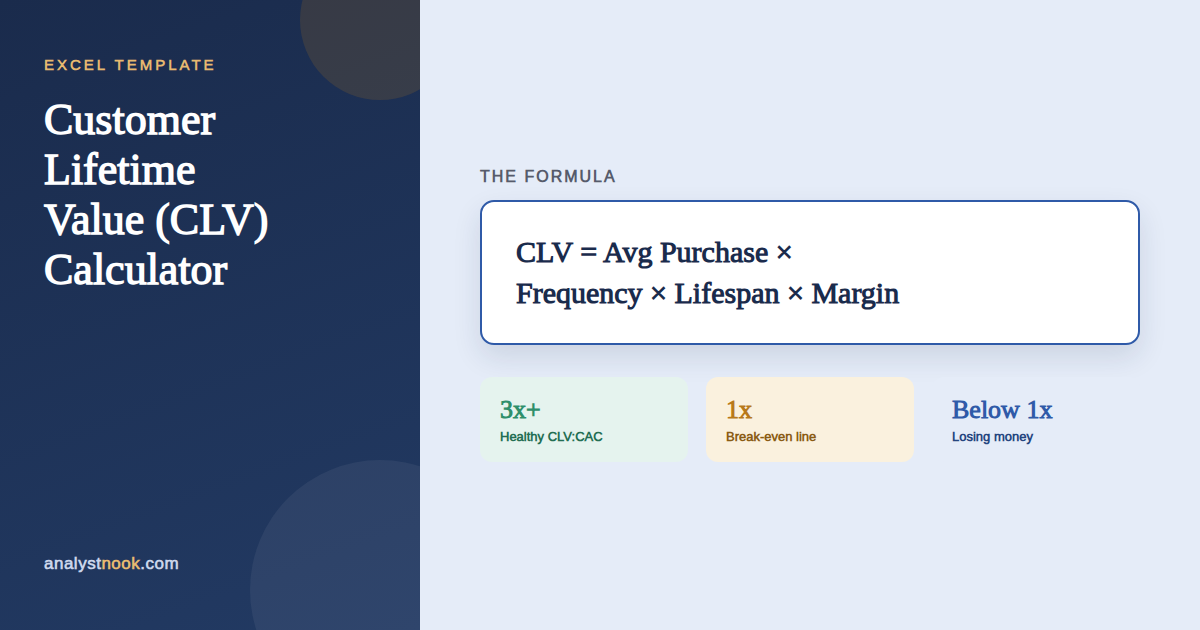
CLV equals average purchase value, multiplied by purchase frequency per year, multiplied by average customer lifespan in years, multiplied by your gross margin percentage. The diagram below breaks down each input and the CLV:CAC benchmarks that follow from the result.
How to Calculate CLV Step by Step
- Find your average purchase value. Total revenue over a period, divided by number of transactions.
- Find your purchase frequency. How many times a typical customer buys from you per year.
- Estimate average customer lifespan. How many years a typical customer keeps buying before they churn.
- Apply your gross margin. CLV should reflect profit, not just revenue — multiply by your gross margin percentage.
- Compare to CAC. Divide CLV by your average cost to acquire a customer for the CLV:CAC ratio.
A Worked Example
Say your average purchase value is $85, customers buy 4 times a year, stay with you for 3 years on average, and your gross margin is 60%. CLV = $85 × 4 × 3 × 0.60 = $612.
If it costs you $150 in ads and sales effort to acquire a new customer, your CLV:CAC ratio is $612 ÷ $150 = 4.08x — comfortably in the healthy 3x–5x range, meaning your acquisition spending is sustainable.
Common Mistakes to Avoid
CLV is simple math built on assumptions that are easy to get wrong. The ones I see most often:
- Using revenue instead of gross profit. A high-revenue, low-margin customer can actually be worth less than a smaller, higher-margin one.
- Guessing at customer lifespan. Pull this from your actual churn data if you have it — 1 ÷ annual churn rate gives you average lifespan in years.
- Treating all customers the same. If you have distinct customer segments, calculate CLV separately for each — a blended average can hide a segment that’s actually unprofitable.
- Comparing CLV to fully-loaded CAC inconsistently. Make sure your CAC includes all acquisition costs — ad spend, commissions, tools — not just media spend.
- Ignoring the ratio entirely. A rising CLV means little if CAC is rising faster — always look at both together.
How to Use the Excel Template
- Enter your average purchase value, purchase frequency, and average customer lifespan in the yellow cells.
- Enter your gross margin percentage.
- Optionally enter your Customer Acquisition Cost to see your CLV:CAC ratio and how it compares to the benchmark guide.
Download the Free CLV Calculator
Download the free CLV Calculator below — no email signup required. Update the inputs with your own numbers and the calculator does the rest.
Want new templates emailed to you?
No spam. Unsubscribe anytime. Downloads never require this.
Need this template customized to your business — a different setup, extra categories, or your own formulas built in? Email me at sharafudin1999@gmail.com or drop a comment below and I’ll help you tweak it.
CLV is most useful alongside a clear view of what each sale actually costs you — our Unit Economics guide and Small Business KPI Dashboard both build on the same numbers.
For more background on the math behind this clv calculator, see Forbes Advisor‘s overview of customer lifetime value.
Frequently Asked Questions
What is a good CLV:CAC ratio?
3:1 or higher is generally considered healthy — each customer is worth at least three times what it costs to acquire them. Below 1:1 means you’re losing money on every new customer; above 5:1 can sometimes mean you’re under-investing in growth.
How do I estimate customer lifespan without churn data?
If you track how many customers you lose each year, divide 1 by your annual churn rate (as a decimal) to get average lifespan in years. Without churn data, a conservative estimate based on how long your typical customer relationship has lasted historically works as a starting point.
Should I use revenue or gross profit for CLV?
Gross profit. CLV is meant to guide how much you can profitably spend to acquire a customer, and that comparison only makes sense against profit, not revenue.
Does CLV change by customer segment?
Often significantly. If you serve distinct customer types (e.g. one-time buyers vs. subscribers, or small vs. enterprise clients), calculate CLV separately for each segment rather than relying on a single blended number.
How often should I recalculate CLV?
Quarterly is a reasonable cadence for most small businesses — enough to catch meaningful shifts in purchase behavior or churn without over-reacting to short-term noise.
