
Petty cash is small enough that it’s tempting to skip tracking it carefully — and that’s exactly how it becomes the line item nobody can explain at year-end. A simple log with a running balance fixes that in about the time it takes to write down a transaction.
This petty cash log template does exactly that: every deposit and withdrawal, who it went to, and a running balance that should always match the actual cash in the drawer.
What Is a Petty Cash Log?
A petty cash log is a running record of every transaction — deposits into and withdrawals from — a small cash fund kept on hand for minor business expenses like postage, parking, or office supplies that aren’t worth writing a check for.
The log’s job is simple but essential: at any moment, the running balance should match exactly what’s physically in the cash drawer. Any mismatch is a signal to investigate immediately, not at year-end.
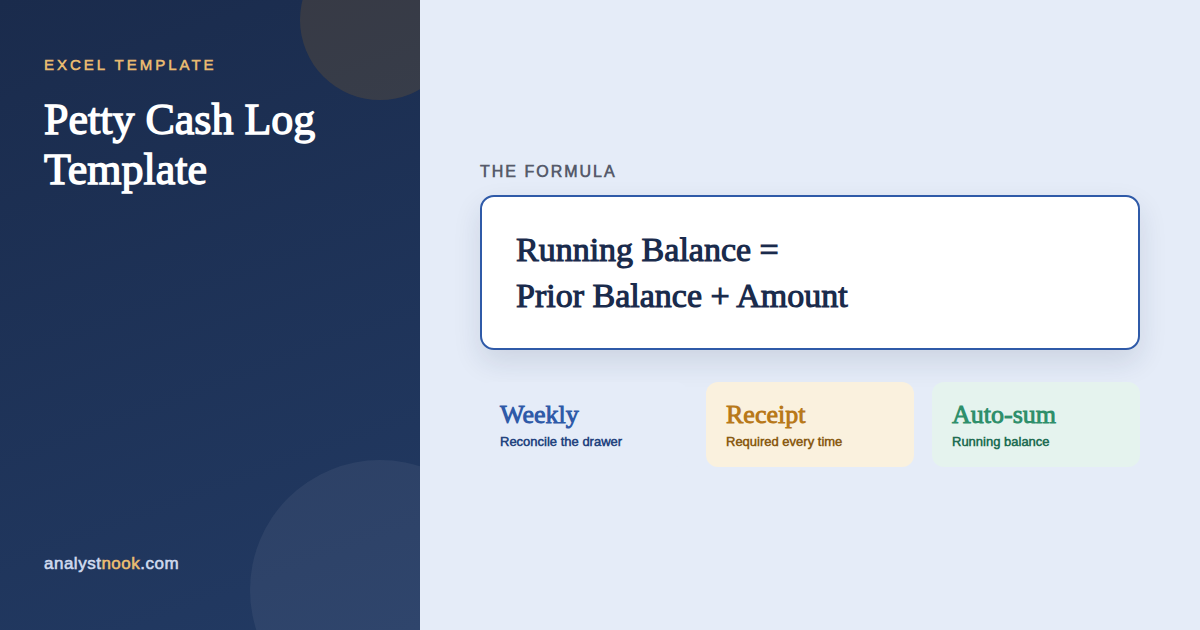
The Running Balance Formula
Each transaction’s running balance equals the prior balance plus the transaction amount — deposits entered as positive numbers, withdrawals as negative. The fund should reconcile to this running total at any point in time.
How to Maintain a Petty Cash Log Step by Step
- Set a starting fund balance and record it as your baseline.
- Log every transaction immediately — date, description, who received or approved it, and the amount.
- Require a receipt or signed voucher for every withdrawal, no exceptions.
- Record fund replenishments as positive deposit entries.
- Reconcile the running balance to the physical cash in the drawer at least weekly.
A Worked Example
Starting from a $300 fund balance, a $24.50 office supply purchase brings the balance to $275.50. A $200 replenishment brings it to $475.50, and three more small withdrawals ($11.20, $18.75, $9.00) bring the running balance down to $436.55.
If the physical drawer only has $420, that $16.55 gap is a signal to track down a missing receipt or an unlogged transaction before it compounds into a larger discrepancy.
Common Mistakes to Avoid
Petty cash discrepancies are almost always process problems, not theft. The usual culprits:
- Logging transactions after the fact, from memory. Log every transaction the moment it happens — delays are where entries get missed.
- Not requiring receipts. A receipt or signed voucher for every withdrawal is the single best control for a petty cash fund.
- Letting the fund grow unchecked. Replenish to a fixed target amount rather than adding cash ad hoc — it makes discrepancies easier to spot.
- Infrequent reconciliation. A monthly reconciliation lets small errors compound; weekly catches them while they’re still easy to trace.
- No single owner. Assign one person responsibility for the fund — shared custody makes accountability harder if the balance doesn’t match.
How to Use the Excel Template
- Enter your starting fund balance in the yellow cell.
- Log each transaction — date, description, who it went to, and the amount (negative for withdrawals, positive for deposits).
- Check the running balance against the physical drawer regularly.
Download the Free Petty Cash Log Template
Download the free Petty Cash Log Template below — no email signup required.
Want new templates emailed to you?
No spam. Unsubscribe anytime. Downloads never require this.
Need this template customized to your business — a different setup, extra categories, or your own formulas built in? Email me at sharafudin1999@gmail.com or drop a comment below and I’ll help you tweak it.
For the rest of your day-to-day expense tracking, our Expense Report Template and Accounts Payable Aging Report cover the transactions too large for petty cash.
For more on keeping small-cash transactions auditable, see Corporate Finance Institute‘s overview of petty cash management, the same process this petty cash log template tracks.
Frequently Asked Questions
How much should a petty cash fund hold?
Most small businesses keep $100–$500 on hand, sized to cover about a month of minor expenses. Keep it as small as practical — the goal is covering incidentals, not becoming a shadow checking account.
Who should be responsible for the petty cash fund?
Assign a single custodian responsible for the fund and its log. Shared access without clear ownership is the most common reason petty cash discrepancies go unexplained.
What counts as a legitimate petty cash expense?
Small, immediate, hard-to-invoice costs — postage, parking, minor office supplies, small client courtesies. Anything recurring or over a modest threshold (many businesses use $25–$50) should go through normal accounts payable instead.
How often should petty cash be reconciled?
Weekly is a good default for an active fund. At minimum, reconcile it every time it’s replenished, and always require a receipt-backed log entry before releasing funds.
What do I do if the petty cash doesn’t reconcile?
Review the log against receipts to find the specific missing or misrecorded entry before assuming a loss. If a small unexplained variance persists after investigation, record it as a miscellaneous expense and tighten the receipt requirement going forward.
