
If every bill came due tomorrow, could you cover it without selling inventory? This quick ratio calculator — built around what’s also called the acid-test ratio — answers exactly that question, and it’s a stricter, more honest liquidity check than the more commonly cited current ratio.
The difference matters most for businesses carrying real inventory: a healthy current ratio can hide a much weaker quick ratio if too much of your current assets are sitting on shelves rather than in the bank.
What Is Quick Ratio?
Quick Ratio measures whether a business can cover its current liabilities using only its most liquid assets — cash, marketable securities, and accounts receivable — deliberately excluding inventory, which can take time and a markdown to convert to cash.
It’s a stricter version of the Current Ratio, which includes inventory in the numerator. Comparing the two tells you how much of your short-term liquidity depends on selling inventory versus assets you could access almost immediately.
The Quick Ratio Formula
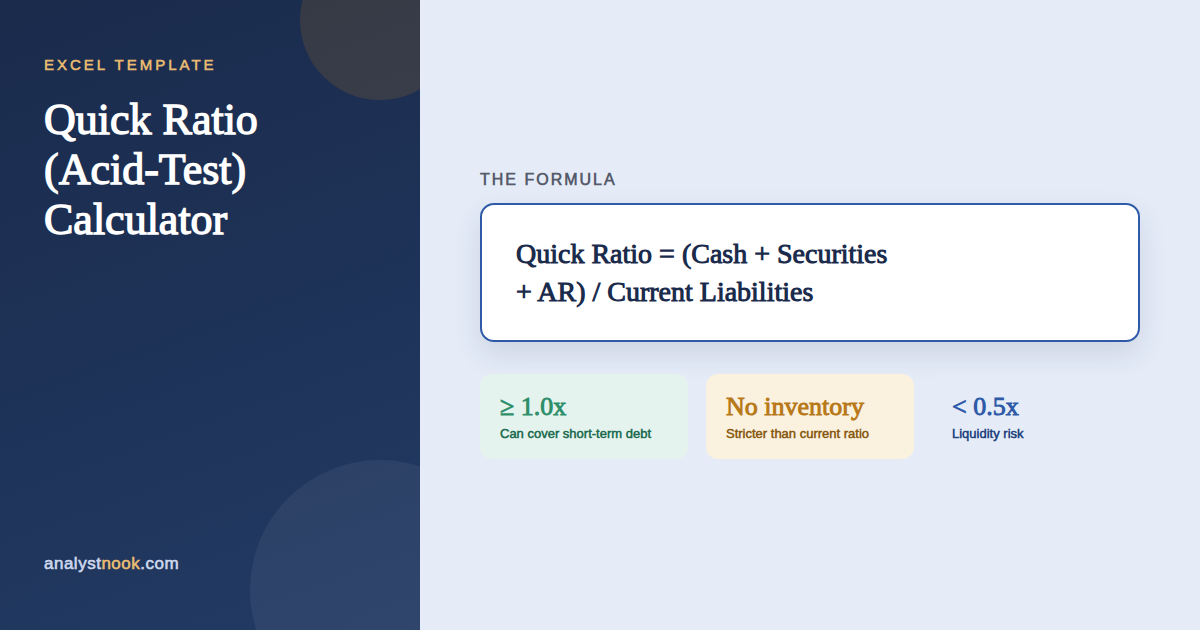
Quick Ratio equals (Cash and Equivalents + Marketable Securities + Accounts Receivable), divided by Total Current Liabilities. Everything in the numerator is an asset you could reasonably convert to cash within days.
How to Calculate Quick Ratio Step by Step
- Pull Cash and Cash Equivalents from your balance sheet.
- Add Marketable Securities, if any.
- Add Accounts Receivable.
- Divide that sum by Total Current Liabilities.
- Compare the result to your Current Ratio (which also includes inventory) to see how much of your liquidity depends on inventory sales.
A Worked Example
With $45,000 in cash, $10,000 in marketable securities, and $38,000 in accounts receivable against $70,000 in current liabilities, Quick Assets total $93,000, giving a Quick Ratio of $93,000 ÷ $70,000 = 1.33x.
Adding $52,000 of inventory to the mix brings the Current Ratio to ($93,000 + $52,000) ÷ $70,000 = 2.07x — a meaningfully rosier picture that depends on successfully converting that inventory to cash.
Common Mistakes to Avoid
Quick Ratio is straightforward, but the interpretation deserves care. The common pitfalls:
- Including inventory in the numerator. That’s the entire point of the quick ratio — if inventory is included, you’ve calculated the current ratio instead.
- Ignoring receivable quality. A large accounts receivable balance full of past-due invoices isn’t as liquid as it looks — check your AR Aging Report alongside this ratio.
- Treating 1.0x as a universal target. Some healthy, well-run businesses operate comfortably below 1.0x if their cash conversion cycle is fast and predictable.
- Only looking at a single point in time. Quick ratio can swing seasonally — track the trend, not just one snapshot.
- Ignoring the gap versus current ratio. A large gap between the two ratios is itself useful information about how inventory-dependent your liquidity really is.
How to Use the Excel Template
- Enter Cash and Cash Equivalents, Marketable Securities, and Accounts Receivable in the yellow cells.
- Enter Inventory (for the Current Ratio comparison) and Total Current Liabilities.
- Read your Quick Ratio and Current Ratio side by side, along with the benchmark guide.
Download the Free Quick Ratio Calculator
Download the free Quick Ratio Calculator below — no email signup required.
Want new templates emailed to you?
No spam. Unsubscribe anytime. Downloads never require this.
Need this template customized to your business — a different setup, extra categories, or your own formulas built in? Email me at sharafudin1999@gmail.com or drop a comment below and I’ll help you tweak it.
Quick Ratio pairs naturally with our Working Capital Calculator and Accounts Receivable Aging Report for a fuller liquidity picture.
For more on how this stricter liquidity test is used, see Corporate Finance Institute‘s overview of the quick ratio, the same number this quick ratio calculator returns.
Frequently Asked Questions
What is a good quick ratio?
1.0x or higher generally means a business can cover its current liabilities without selling inventory or raising new financing. Ratios between 0.5x and 1.0x warrant attention, and below 0.5x suggests real liquidity risk.
What’s the difference between quick ratio and current ratio?
Current ratio includes inventory as a current asset; quick ratio deliberately excludes it, since inventory can take time and sometimes a markdown to convert to cash. Quick ratio is the more conservative liquidity measure.
Why would quick ratio be much lower than current ratio?
A large gap usually means a significant share of current assets is tied up in inventory — common in retail, manufacturing, and distribution businesses. It’s not automatically a red flag, but it’s worth understanding.
Should accounts receivable always count as a quick asset?
In principle yes, but if a large share of receivables is significantly past due, treat the quick ratio as somewhat optimistic — cross-check with an AR Aging Report to see how collectible those receivables really are.
How often should I calculate my quick ratio?
Monthly or quarterly is typical, and more frequently if your business has seasonal cash flow swings or is managing tight liquidity.
