
Every fixed asset your business owns loses value over its useful life, and your books need to reflect that loss year by year — not all at once, and not never. This depreciation schedule template lays out exactly how much value to write off each year, for exactly how long.
This template builds the full year-by-year schedule for a single asset automatically, once you enter its cost, salvage value, and useful life — with a built-in check to confirm your numbers are right.
What Is a Depreciation Schedule?
A Depreciation Schedule is a year-by-year breakdown of how an asset’s cost is expensed over its useful life. It shows the depreciation charge for each year, the accumulated depreciation to date, and the resulting Net Book Value.
The most common method for small businesses is straight-line depreciation, which expenses an equal amount every year. Other methods (declining balance, units of production) exist for specific cases but add complexity most small businesses don’t need.
The Straight-Line Depreciation Formula
Annual Depreciation equals (Cost minus Salvage Value) divided by Useful Life in years. That same amount is charged every year until the asset’s Net Book Value reaches its Salvage Value.
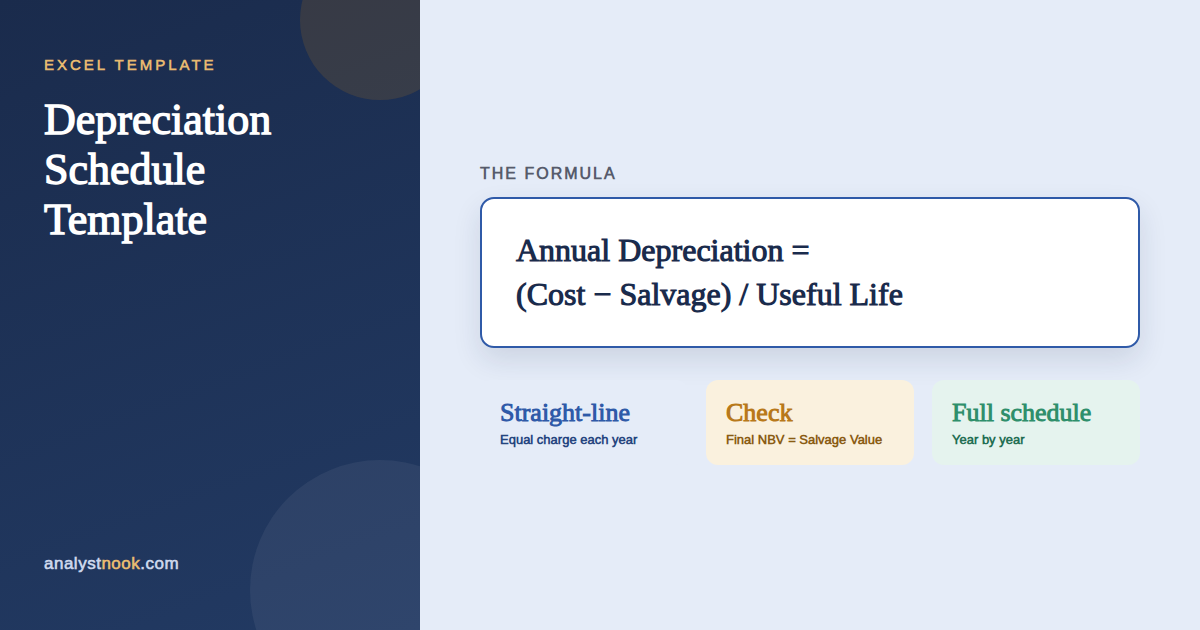
How to Build a Depreciation Schedule Step by Step
- Enter the asset’s original cost.
- Estimate its salvage value — what it will likely be worth (or sell for) at the end of its useful life.
- Determine its useful life in years, based on how long you expect to use it or standard guidance for that asset type.
- Calculate Annual Depreciation: (Cost minus Salvage Value) divided by Useful Life.
- Build the year-by-year schedule, checking that the final year’s Net Book Value equals your Salvage Value exactly.
A Worked Example
A $32,000 asset with a $2,000 salvage value and a 5-year useful life depreciates at ($32,000 − $2,000) ÷ 5 = $6,000 per year. After year 1, accumulated depreciation is $6,000 and Net Book Value is $26,000.
By year 5, accumulated depreciation reaches $30,000 and Net Book Value lands at exactly $2,000 — matching the salvage value input and confirming the schedule is built correctly.
Common Mistakes to Avoid
Depreciation schedules are formulaic, which makes small input errors easy to miss. Watch for these:
- Forgetting salvage value entirely. Depreciating the full cost to zero overstates the annual expense if the asset will actually be worth something at disposal.
- Using an unrealistic useful life. Check standard useful-life guidance for the asset category, or your accountant’s recommendation, rather than guessing.
- Not checking that the schedule ends at salvage value. If the final year’s Net Book Value doesn’t match your salvage value input, there’s an error in the schedule.
- Mixing book and tax depreciation. Many jurisdictions allow accelerated depreciation for tax purposes that differs from straight-line book depreciation — keep the two separate and clearly labeled.
- Not updating the schedule after a major repair or improvement. A significant improvement that extends useful life may warrant adjusting the remaining schedule.
How to Use the Excel Template
- Enter the asset’s Cost, Salvage Value, Useful Life, and Purchase Year in the yellow cells.
- Review the automatically generated year-by-year schedule.
- Confirm the final year’s Net Book Value matches your Salvage Value as a built-in accuracy check.
Download the Free Depreciation Schedule Template
Download the free Depreciation Schedule Template below — no email signup required.
Want new templates emailed to you?
No spam. Unsubscribe anytime. Downloads never require this.
Need this template customized to your business — a different setup, extra categories, or your own formulas built in? Email me at sharafudin1999@gmail.com or drop a comment below and I’ll help you tweak it.
Use this alongside our Fixed Asset Register Template to track all your assets in one place, and our Profit and Loss Statement Template to see how the depreciation expense flows through to your bottom line.
For the official rules behind these calculations, see the IRS’s Publication 946, which this depreciation schedule template follows for straight-line depreciation.
Frequently Asked Questions
What depreciation method should a small business use?
Straight-line is the simplest and most common method for small business books — it expenses an equal amount each year and is easy to explain to lenders, partners, or an accountant. Tax rules in your jurisdiction may allow or require a different method for tax filings specifically.
How do I determine an asset’s useful life?
Many jurisdictions publish standard useful-life guidance by asset category for tax purposes; for book purposes, base it on how long you realistically expect to use the asset before replacing it.
What is salvage value and how do I estimate it?
Salvage value is what you expect an asset to be worth (through sale or trade-in) at the end of its useful life. For assets with little resale value, it’s reasonable to estimate $0 or a small nominal amount.
Does depreciation affect my cash flow?
No — depreciation is a non-cash expense. It reduces reported profit on your income statement but doesn’t involve any cash leaving the business in the years after the original purchase.
What happens if I sell an asset before it’s fully depreciated?
You’ll typically recognize a gain or loss on disposal — the difference between the sale price and the asset’s Net Book Value at the time of sale. Update your Fixed Asset Register to remove the asset once disposed.
