
Before you commit to a big purchase, there’s a simpler question than NPV or IRR: how long until this pays for itself? This payback period calculator answers exactly that — the number of years it takes for a project’s cumulative cash flow to recover what you spent upfront.
It’s not the most sophisticated capital budgeting tool, but it’s often the most intuitive one for small business owners making a gut-check decision, and it doubles as a quick risk filter: the longer the payback, the more that can go wrong before you break even.
What Is Payback Period?
Payback Period is the amount of time — usually in years — it takes for the cumulative cash flow from a project to equal the amount originally invested. Once cumulative cash flow crosses from negative to positive, you’ve hit payback.
It’s a liquidity and risk measure, not a profitability measure: it tells you how exposed your capital is, and for how long, but it says nothing about what happens to cash flows after the payback point.
The Payback Period Formula
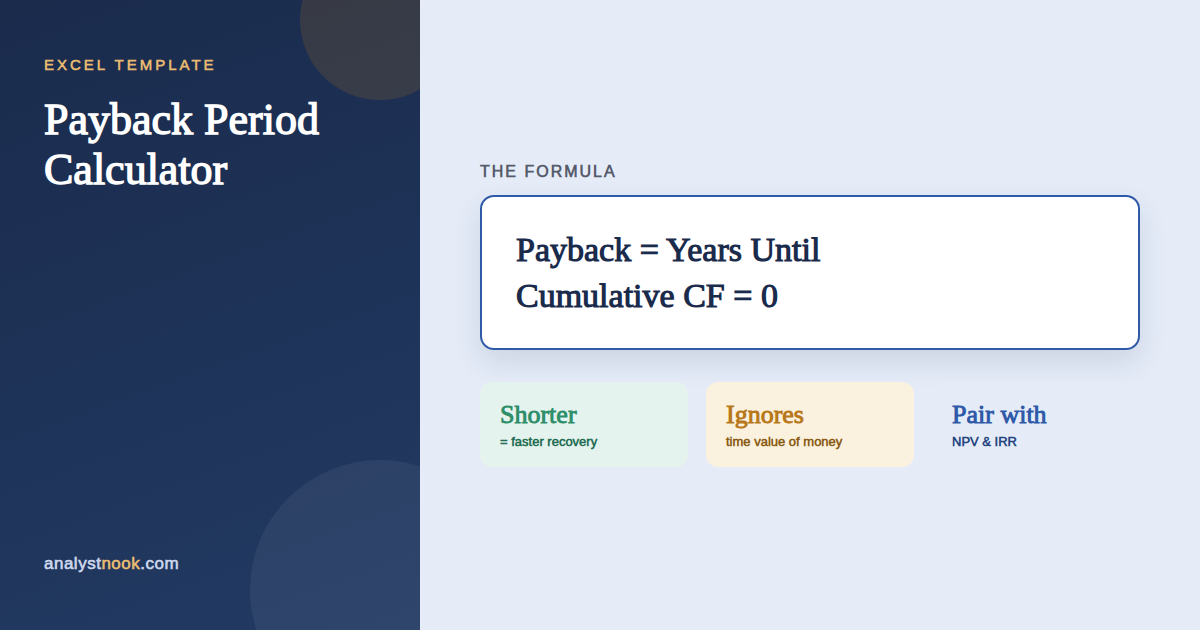
Track cumulative cash flow year by year, starting with -Initial Investment. Payback Period is the year that cumulative flow first turns positive, interpolated for a fractional answer if the crossover happens partway through a year.
How to Calculate Payback Period Step by Step
- Enter your initial investment as a negative starting cumulative cash flow.
- Add each year’s net cash flow to build a running cumulative total.
- Find the year where cumulative cash flow crosses from negative to positive.
- Interpolate within that year: divide the remaining negative balance by that year’s cash flow to get a fractional year.
- Add that fraction to the number of full years elapsed for your final Payback Period.
A Worked Example
Suppose you invest $60,000 in a piece of equipment expected to generate $18,000, $20,000, and $22,000 in the first three years. Cumulative cash flow is -$42,000 after year 1, -$22,000 after year 2, and exactly $0 after year 3 — a clean 3.0-year payback.
If year 3’s cash flow had instead been $30,000, the $22,000 remaining balance would recover partway through the year: $22,000 ÷ $30,000 ≈ 0.73, for a payback period of about 2.73 years.
Common Mistakes to Avoid
Payback Period is simple, which is exactly why it’s easy to misuse. Watch for these:
- Treating it as the only decision tool. Payback ignores the time value of money and every cash flow after the payback point — always pair it with NPV or IRR.
- Comparing projects with very different lifespans. A 2-year payback on a project that only lasts 3 years is very different from a 2-year payback on a 10-year asset.
- Using revenue instead of net cash flow. Same rule as NPV — use what actually hits your bank account, after costs.
- Ignoring risk beyond the payback window. A short payback with declining cash flows afterward can be worse than a longer payback with a steady, growing stream.
- Skipping the interpolation. Rounding to the nearest full year hides real differences between projects that both “pay back in year 3.”
How to Use the Excel Template
- Enter your initial investment in the yellow cell.
- Enter each year’s expected net cash flow for up to 10 years.
- Read the interpolated Payback Period, along with the year-by-year cumulative cash flow, in the results panel.
Download the Free Payback Period Calculator
Download the free Payback Period Calculator below — no email signup required. Enter your own cash flows and the payback period updates instantly.
Want new templates emailed to you?
No spam. Unsubscribe anytime. Downloads never require this.
Need this template customized to your business — a different setup, extra categories, or your own formulas built in? Email me at sharafudin1999@gmail.com or drop a comment below and I’ll help you tweak it.
For a fuller picture of whether the same project creates value — not just how fast it repays — pair this with our NPV Calculator, and use the Financial Model Template to see how it affects your full projections.
For more on how this metric complements NPV and IRR, see Corporate Finance Institute‘s overview of the payback period, the same concept this payback period calculator is built around.
Frequently Asked Questions
What is a good payback period for a small business?
It depends heavily on the asset and industry, but many small businesses target 1–3 years for equipment purchases. Longer-lived assets like real estate or major infrastructure can justify a longer payback.
Does payback period account for the time value of money?
No — standard payback period treats every dollar the same regardless of when it arrives. A variant called “discounted payback period” does account for it by discounting each year’s cash flow first, similar to NPV.
What’s the difference between payback period and NPV?
Payback period tells you how long until you recover your investment; NPV tells you how much value the project creates over its entire life, accounting for the time value of money. A project can have a short payback and still have a lower NPV than an alternative with a longer payback.
Can payback period be negative or the project never pay back?
If cumulative cash flow never turns positive within the project’s useful life, the project simply doesn’t pay back — that’s a strong signal to reject it regardless of any other metric.
Should I use payback period alone to make a decision?
No — use it as a quick risk and liquidity screen, then confirm with NPV and IRR before committing significant capital.
