
Every small business owner eventually faces the same decision: should I spend money now to make more money later? New equipment, a second location, a marketing push, hiring ahead of demand — each one is a bet that future cash flows will beat what the money could earn sitting somewhere else. Net Present Value (NPV) is the tool that turns that gut feeling into a number.
I built the NPV calculator below because most NPV explanations jump straight into finance-textbook notation and lose people before they get a usable answer. Enter your discount rate, your upfront cost, and your expected cash flows, and it hands you three numbers you can actually act on: NPV, IRR, and a Profitability Index. Here’s how each one works and what to do with them.
What Is Net Present Value?
Net Present Value is the sum of all future cash flows a project will generate, each discounted back to today’s dollars, minus what you have to spend upfront to get it started. The discounting matters because a dollar next year is worth less than a dollar today — it could have been earning interest, or invested somewhere else, in the meantime.
A positive NPV means the project is expected to generate more value than it costs, once you account for that time value of money. A negative NPV means the opposite: even if the project looks profitable on paper, it doesn’t clear the bar you set with your discount rate.
The NPV Formula
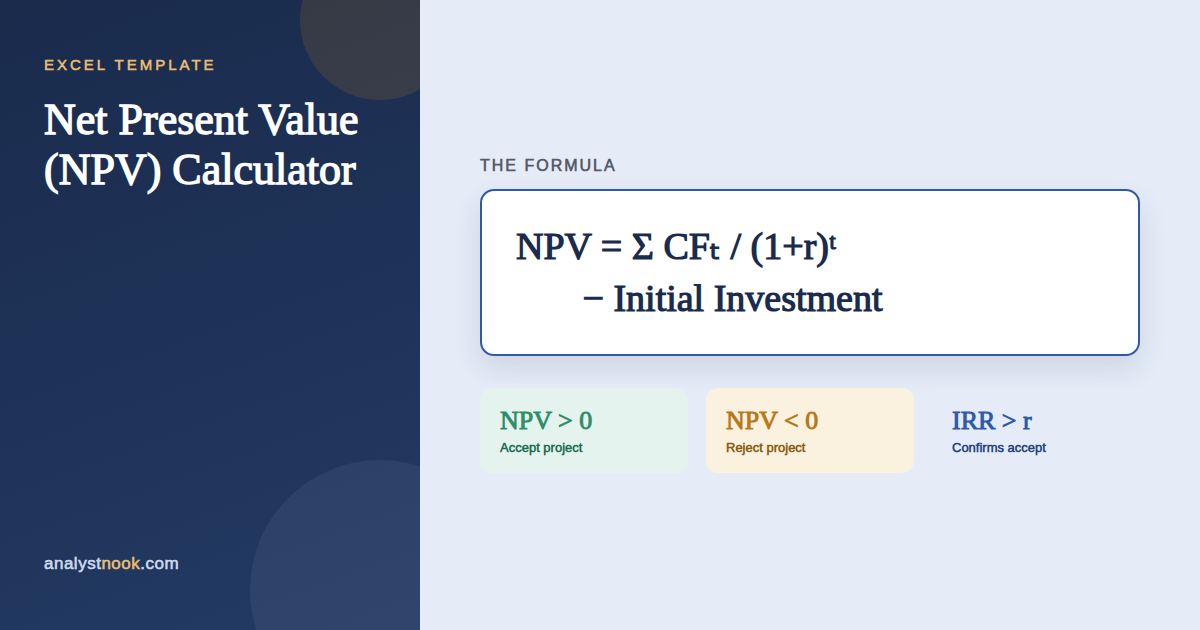
In plain terms: take each year’s expected net cash flow, divide it by (1 + your discount rate) raised to that year’s power, add them all together, then subtract your initial investment. The diagram below shows the full formula and the decision rule that follows from it.
How to Calculate NPV Step by Step
- Choose a discount rate. This is usually your cost of capital — what it costs you to borrow, or what return you could get investing the money elsewhere. Many small businesses use 8–15%.
- Estimate your initial investment. Every upfront cost: equipment, deposits, setup labor, initial inventory.
- Project your annual net cash flows. Be conservative — use the cash flow the project actually generates, not revenue.
- Discount each year’s cash flow back to today. Divide by (1 + rate) to the power of the year number.
- Sum the discounted cash flows and subtract the initial investment. That’s your NPV.
A Worked Example
Say you’re considering a $50,000 piece of equipment that you expect will generate $15,000, $16,000, $17,000, $18,000, and $19,000 in net cash flow over the next five years. Using a 10% discount rate, the calculator returns an NPV of roughly $13,700 and an IRR of about 19.8%.
Because the NPV is positive and the IRR (19.8%) clears your 10% discount rate, this equipment purchase adds value at your cost of capital — a reasonable case to move forward, assuming your cash flow estimates hold up.
Common Mistakes to Avoid
I’ve reviewed a lot of investment decisions that fell apart after the fact, and almost every one traced back to one of these:
- Using revenue instead of cash flow. NPV needs net cash flow — after costs, taxes, and working capital changes — not top-line sales.
- Picking a discount rate that flatters the project. If you have to lower your discount rate to make the NPV positive, that’s a sign to look harder at the assumptions, not the rate.
- Ignoring cash flow timing. A dollar in year 1 is worth more than a dollar in year 5 — that’s the entire point of discounting. Don’t flatten your projections into an average.
- Forgetting terminal or salvage value. If the equipment or asset has resale value at the end of the period, add it as a cash inflow in the final year.
- Relying on NPV alone. Always check it against IRR and Profitability Index — if they disagree, dig into why before deciding.
How to Use the Excel Template
- Open the NPV Calculator tab and enter your discount rate in the yellow cell.
- Enter your initial investment as a positive number.
- Enter each year’s expected net cash flow for up to 10 years — leave unused years blank or at zero.
- Read your NPV, IRR, and Profitability Index in the results panel, along with the built-in decision guide.
Download the Free NPV Calculator
Download the free NPV Calculator below — no email signup required. It’s a single Excel file with live formulas, so you can plug in your own numbers and see the result update instantly.
Want new templates emailed to you?
No spam. Unsubscribe anytime. Downloads never require this.
Need this template customized to your business — a different setup, extra categories, or your own formulas built in? Email me at sharafudin1999@gmail.com or drop a comment below and I’ll help you tweak it.
Once you have a positive NPV project on your hands, the next question is usually how to fund it and what it does to your cash position — our Financial Model Template and Cash Flow Forecast Template are the natural next steps.
For a deeper dive into the theory behind this npv calculator, see Corporate Finance Institute‘s overview of net present value analysis.
Frequently Asked Questions
What is a good NPV for a small business project?
There’s no universal “good” number — NPV is in dollars, so a $500 NPV on a $2,000 investment is a much stronger result than the same $500 on a $200,000 investment. Focus on whether NPV is positive at your real cost of capital, and compare the Profitability Index (NPV as a percentage of investment) across competing projects.
What discount rate should I use for NPV?
Most small businesses use their cost of capital — roughly the interest rate on a business loan, or the return they could reasonably expect investing the cash elsewhere. 8–15% is a common range; higher-risk projects should use a higher rate.
What’s the difference between NPV and IRR?
NPV tells you the dollar value a project adds at a chosen discount rate. IRR tells you the discount rate at which NPV would be exactly zero — effectively the project’s own rate of return. They usually agree on accept/reject decisions, but NPV is the better measure when comparing projects of different sizes.
Can NPV be used for personal investment decisions?
Yes — the same logic applies to any decision with an upfront cost and future cash flows, including comparing a rental property’s returns or evaluating a franchise purchase. The math doesn’t change, only the inputs.
Does this template handle uneven cash flows?
Yes. Each year’s cash flow is entered independently, so you can model growth, decline, seasonality, or a one-time spike (like a large contract renewal) in any year without adjusting the formulas.
