
You can’t budget, hire, or plan inventory purchases around sales you haven’t projected. This sales forecast template doesn’t need to be complicated to be useful — a simple growth-rate model, built honestly and revisited monthly, beats an elaborate model nobody updates.
This template starts with your current monthly sales and a growth rate assumption, then projects 12 months forward automatically, along with the gross profit that comes with it.
What Is a Sales Forecast?
A sales forecast is a projection of expected future revenue, typically built month by month for the year ahead. It’s the foundation for budgeting, staffing decisions, inventory purchasing, and cash flow planning — almost every other financial plan in a small business starts here.
The simplest useful forecast applies a consistent growth rate to a known baseline. More sophisticated versions layer in seasonality, new product launches, or marketing campaigns, but the growth-rate model is a strong starting point for most small businesses.
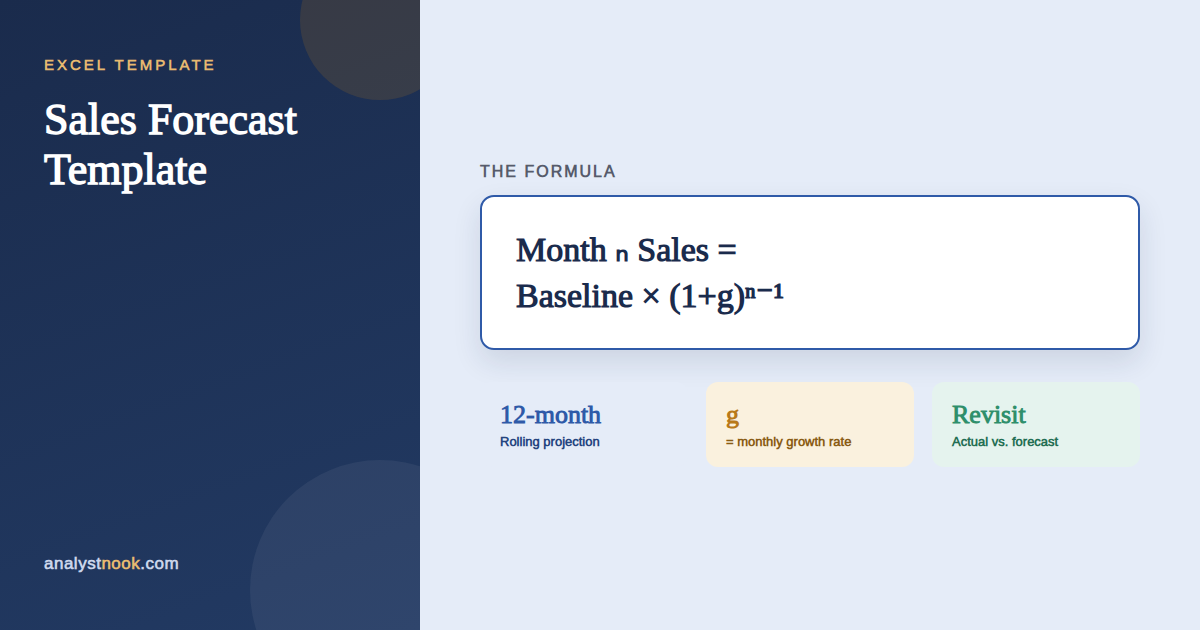
The Sales Forecast Formula
Each month’s forecast sales equals the prior month’s sales multiplied by (1 + your monthly growth rate). Applying gross margin to each month’s forecast gives you projected gross profit alongside revenue.
How to Build a Sales Forecast Step by Step
- Establish your Month 1 baseline — typically your most recent month’s actual sales, or an average of the last few months.
- Estimate a realistic monthly growth rate based on your recent trend, not your goals.
- Apply that growth rate forward for each of the next 12 months.
- Apply your gross margin percentage to see projected gross profit alongside revenue.
- Replace projected months with actuals as they come in, and recalculate your growth rate periodically.
A Worked Example
Starting from $32,000 in Month 1 sales with a 3% monthly growth rate and a 55% gross margin, Month 12 sales project to roughly $44,200, and the full 12-month forecast totals just over $455,000 in sales and $250,000 in gross profit.
If actual growth comes in closer to 1.5% a month instead of 3%, updating that single assumption cell reflows every month’s projection automatically — no need to rebuild the model.
Common Mistakes to Avoid
A forecast is only as useful as the discipline behind it. The most common issues I see:
- Forecasting from goals instead of trends. A growth rate should reflect what’s actually happened recently, adjusted for known upcoming changes — not what you’d like to happen.
- Never revisiting the forecast. A forecast built once in January and never checked against actuals stops being useful by March.
- Ignoring seasonality. If your business has predictable seasonal swings, a flat growth rate will systematically over- or under-forecast certain months.
- Forecasting revenue without margin. Revenue growth means little if it comes with shrinking margins — always forecast gross profit alongside sales.
- Using overly optimistic baselines. A single unusually strong month as your Month 1 baseline will overstate the entire year.
How to Use the Excel Template
- Enter your Month 1 baseline sales in the yellow cell.
- Enter your expected monthly growth rate.
- Enter your gross margin percentage to see projected gross profit alongside sales.
- Overwrite any month’s forecast with actual results as they come in to keep the model current.
Download the Free Sales Forecast Template
Download the free Sales Forecast Template below — no email signup required.
Want new templates emailed to you?
No spam. Unsubscribe anytime. Downloads never require this.
Need this template customized to your business — a different setup, extra categories, or your own formulas built in? Email me at sharafudin1999@gmail.com or drop a comment below and I’ll help you tweak it.
Pair this forecast with our Cash Flow Forecast Template to see how projected sales translate into actual cash in the bank, and our Small Business KPI Dashboard to track forecast accuracy over time.
For more guidance on forecasting responsibly, see the U.S. Small Business Administration‘s tips for sales forecasting, which pair well with this sales forecast template.
Frequently Asked Questions
How accurate should a sales forecast be?
Perfect accuracy isn’t realistic or the goal — a useful forecast is directionally right and gets revisited often enough to correct course. Track forecast vs. actual each month to see how far off your assumptions typically run.
What growth rate should I use if I’m a new business with no history?
Without your own trend data, research comparable businesses in your industry and market, and lean conservative — it’s easier to revise a forecast upward than to have built a budget around numbers that didn’t materialize.
Should I forecast weekly, monthly, or quarterly?
Monthly is the most common cadence for small businesses — granular enough to catch trends early, without the noise of weekly data or the lag of quarterly reviews.
How do I account for seasonality in this template?
Overwrite the automatic growth-rate projection for specific months with your own seasonal estimate (e.g., a holiday spike or a summer slowdown) — the formulas for gross profit will still apply correctly to whatever sales figure you enter.
What’s the difference between a sales forecast and a budget?
A sales forecast projects expected revenue; a budget plans expenses against that revenue (and other funding). The forecast is typically built first, since planned spending should follow expected income, not the other way around.
