
Lenders and investors look at one ratio almost immediately when they evaluate a business: how much of it is financed by debt versus how much belongs to the owners. Debt to Equity Ratio answers that question in a single number, and it’s worth knowing your own before a bank pulls it for you.
This debt to equity ratio calculator gives you the ratio instantly from two numbers already sitting on your balance sheet, along with a benchmark guide to interpret what you get.
What Is Debt-to-Equity Ratio?
Debt-to-Equity (D/E) Ratio compares your total liabilities to your total shareholders’ equity, measuring how much of your business is financed by borrowed money versus owner investment and retained earnings.
A D/E of 1.0 means debt and equity are equal. Higher ratios mean more leverage — more financial risk, but also potentially higher returns on equity if the borrowed capital is deployed well.
The Debt-to-Equity Formula
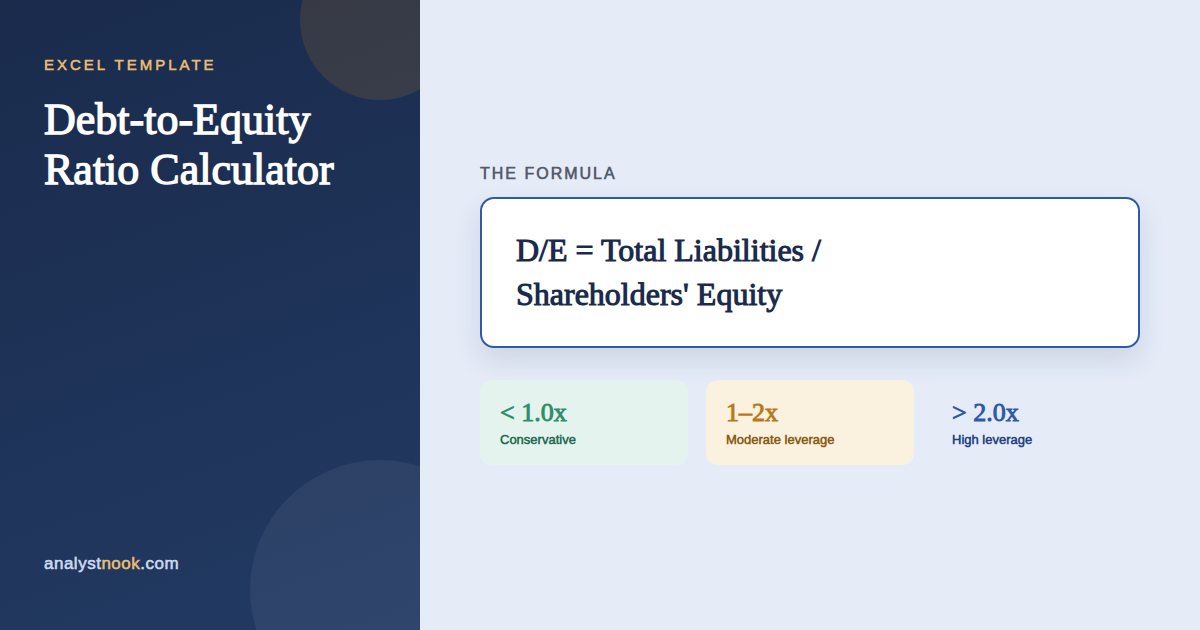
D/E Ratio equals Total Liabilities divided by Total Shareholders’ Equity, both taken from the same balance sheet date. A related figure, the Equity Multiplier (Total Assets ÷ Equity), shows the same leverage from a slightly different angle.
How to Calculate Debt-to-Equity Ratio Step by Step
- Pull Total Liabilities from your balance sheet — the sum of current and long-term liabilities.
- Pull Total Shareholders’ Equity from the same balance sheet date.
- Divide Total Liabilities by Total Equity for your D/E Ratio.
- Optionally calculate the Equity Multiplier (Total Assets ÷ Equity) as a cross-check.
A Worked Example
If your balance sheet shows $340,000 in total liabilities and $260,000 in shareholders’ equity, your D/E Ratio is $340,000 ÷ $260,000 = 1.31x — meaning you have $1.31 of debt for every dollar of equity.
Total assets in this example are $600,000 (liabilities plus equity), giving an Equity Multiplier of 2.31x — a consistent view of the same moderate-to-elevated leverage.
Common Mistakes to Avoid
D/E Ratio is a simple calculation, but the interpretation trips people up. The common issues:
- Comparing across industries without adjustment. Capital-intensive industries like real estate or utilities structurally run higher D/E than service businesses.
- Using book value equity when the business has unusual accounting. Heavy owner draws or accumulated losses can distort equity — look at the trend, not just one snapshot.
- Ignoring the composition of debt. A high D/E driven by long-term, low-interest debt is very different from the same ratio driven by high-interest short-term borrowing.
- Treating low D/E as automatically good. Very low leverage can also mean you’re not using debt to fund growth when it would be cost-effective to do so.
- Not tracking it over time. A rising D/E ratio quarter over quarter is often an earlier warning sign than any single period’s absolute number.
How to Use the Excel Template
- Enter your Total Liabilities in the yellow cell.
- Enter your Total Shareholders’ Equity for the same date.
- Read your Debt-to-Equity Ratio and Equity Multiplier in the results panel, along with the benchmark guide.
Download the Free Debt to Equity Ratio Calculator
Download the free Debt-to-Equity Ratio Calculator below — no email signup required.
Want new templates emailed to you?
No spam. Unsubscribe anytime. Downloads never require this.
Need this template customized to your business — a different setup, extra categories, or your own formulas built in? Email me at sharafudin1999@gmail.com or drop a comment below and I’ll help you tweak it.
For the full picture of your financial position, this pairs naturally with our Balance Sheet Template and Working Capital Calculator.
For more on how lenders read this number, see Corporate Finance Institute‘s overview of the debt-to-equity ratio, the same figure this debt to equity ratio calculator produces.
Frequently Asked Questions
What is a good debt-to-equity ratio for a small business?
Below 1.0x is generally considered conservative, and 1.0x–2.0x is common for many small businesses using moderate leverage. Above 2.0x signals higher risk to lenders, though capital-intensive industries can run structurally higher.
What does a debt-to-equity ratio of 0 mean?
A ratio of 0 means the business has no liabilities and is entirely equity-financed — unusual in practice, since even accounts payable and accrued expenses count as liabilities.
How is debt-to-equity different from the equity multiplier?
Both measure leverage, but D/E compares liabilities directly to equity, while the Equity Multiplier compares total assets to equity. They’re mathematically related (Equity Multiplier = D/E + 1) and tend to move together.
Does debt-to-equity ratio include all liabilities or just loans?
Standard D/E uses total liabilities, including accounts payable, accrued expenses, and both short- and long-term debt. Some analysts calculate a variant using only interest-bearing debt — be consistent about which version you’re using when comparing periods.
How often do lenders check debt-to-equity ratio?
Most lenders review it at loan origination and often as an ongoing covenant, checked quarterly or annually depending on the loan agreement — knowing your own number ahead of time avoids surprises.
