
If someone asked you right now for a complete list of everything your business owns — equipment, vehicles, furniture, with what it cost and what it’s worth today — could you produce it in five minutes? This fixed asset register template is that list, and it’s one of the most-requested documents at tax time, during an audit, or when applying for financing.
This template tracks every asset’s cost, useful life, and depreciation in one place, with Net Book Value calculating automatically as time passes.
What Is a Fixed Asset Register?
A Fixed Asset Register is a master log of every fixed asset a business owns — equipment, vehicles, furniture, buildings — recording each asset’s description, purchase date, cost, useful life, and accumulated depreciation.
It exists to keep your books, insurance coverage, and tax filings all agreeing on the same set of facts: what you own, what it originally cost, and what it’s currently worth on the books.
The Net Book Value Formula
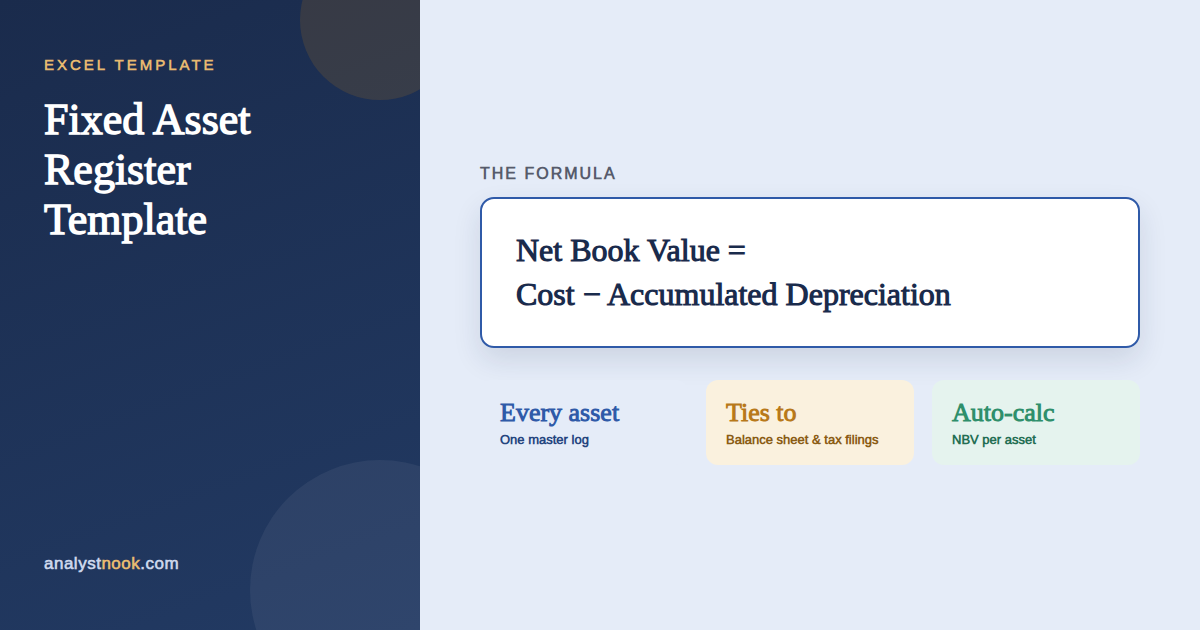
Net Book Value equals an asset’s original Cost minus its Accumulated Depreciation to date. Accumulated Depreciation builds up each year using straight-line depreciation: (Cost minus Salvage Value) divided by Useful Life.
How to Build a Fixed Asset Register Step by Step
- List every fixed asset with a clear description — specific enough to identify it (make, model, or serial number if useful).
- Record the purchase date, cost, salvage value, and useful life in years for each asset.
- Track full years owned so accumulated depreciation calculates correctly.
- Let Annual Depreciation, Accumulated Depreciation, and Net Book Value calculate automatically.
- Update the register whenever an asset is purchased, disposed of, or fully depreciated.
A Worked Example
A delivery van purchased for $32,000 with a $5,000 salvage value and a 6-year useful life depreciates at ($32,000 − $5,000) ÷ 6 = $4,500 per year. After 3 full years owned, accumulated depreciation is $13,500 and Net Book Value is $32,000 − $13,500 = $18,500.
Across a full register of several assets, the Total Cost, Total Accumulated Depreciation, and Total Net Book Value columns roll up automatically — the numbers that should tie directly to your balance sheet’s fixed asset line.
Common Mistakes to Avoid
A Fixed Asset Register that isn’t kept current is worse than not having one, because it creates false confidence. Watch for these:
- Not updating it when assets are disposed of. A register listing equipment you sold or scrapped years ago will throw off your balance sheet.
- Mixing depreciation methods without noting it. If you use different methods (straight-line vs. accelerated) for book vs. tax purposes, document which is which clearly.
- Underestimating useful life. An unrealistically short useful life front-loads depreciation and can distort near-term profitability.
- Skipping small assets. Even modest-cost equipment should be tracked if it has meaningful useful life — a register with gaps undermines its own purpose.
- Not reconciling to the balance sheet. The register’s totals should match your books exactly — a discrepancy usually means an asset was added or removed in one place but not the other.
How to Use the Excel Template
- Enter each asset’s description, purchase date, cost, salvage value, and useful life in the yellow cells.
- Update Full Years Owned at each year-end.
- Let Annual Depreciation, Accumulated Depreciation, and Net Book Value calculate automatically for every asset.
Download the Free Fixed Asset Register Template
Download the free Fixed Asset Register Template below — no email signup required.
Want new templates emailed to you?
No spam. Unsubscribe anytime. Downloads never require this.
Need this template customized to your business — a different setup, extra categories, or your own formulas built in? Email me at sharafudin1999@gmail.com or drop a comment below and I’ll help you tweak it.
Keep this register in sync with your Balance Sheet Template and our Depreciation Schedule Template for a detailed year-by-year breakdown of any single asset.
For more on how fixed assets are classified and depreciated, see Thomson Reuters‘s overview of fixed assets, the same records this fixed asset register template is built to track.
Frequently Asked Questions
What counts as a fixed asset?
A fixed asset is a tangible item a business owns and uses for more than one year to generate revenue — equipment, vehicles, furniture, and buildings are the most common examples. It excludes inventory held for sale and short-lived supplies.
How often should I update my fixed asset register?
Update it immediately whenever an asset is purchased or disposed of, and review accumulated depreciation at least annually — monthly or quarterly if your business acquires assets frequently.
What’s the difference between a fixed asset register and a depreciation schedule?
The register is a master list of every asset the business owns; a depreciation schedule details the year-by-year depreciation for one specific asset. Most businesses maintain a summary register and a detailed schedule for larger assets.
Do I need a fixed asset register for tax purposes?
In most jurisdictions, yes — tax authorities typically require supporting documentation for depreciation deductions claimed, and a maintained register is the standard way to provide it. Check with a local accountant for your specific requirements.
What should I do when I dispose of an asset?
Remove it from the active register (or mark it as disposed with the date and any sale proceeds), and record any gain or loss on disposal — the difference between sale proceeds and Net Book Value at the time of sale.
