
Most small business owners get this wrong in one of two directions. Some wait too long — doing their own books in a spreadsheet until a missed tax deadline or a loan application they can’t support forces a scramble. Others overpay too early — hiring a $10,000/month fractional CFO when what they actually needed was twenty hours a month of bookkeeping.
The confusion is understandable. Bookkeeper, accountant, and CFO sound like a ladder of the same job at increasing seniority, but they’re not — they solve different problems, and most businesses eventually need more than one at the same time, not one replacing another. Once you see bookkeeper vs accountant vs CFO as three separate jobs rather than three ranks of the same job, the decision gets a lot less confusing.
Bookkeeper vs. Accountant vs. CFO: What Each Role Actually Does
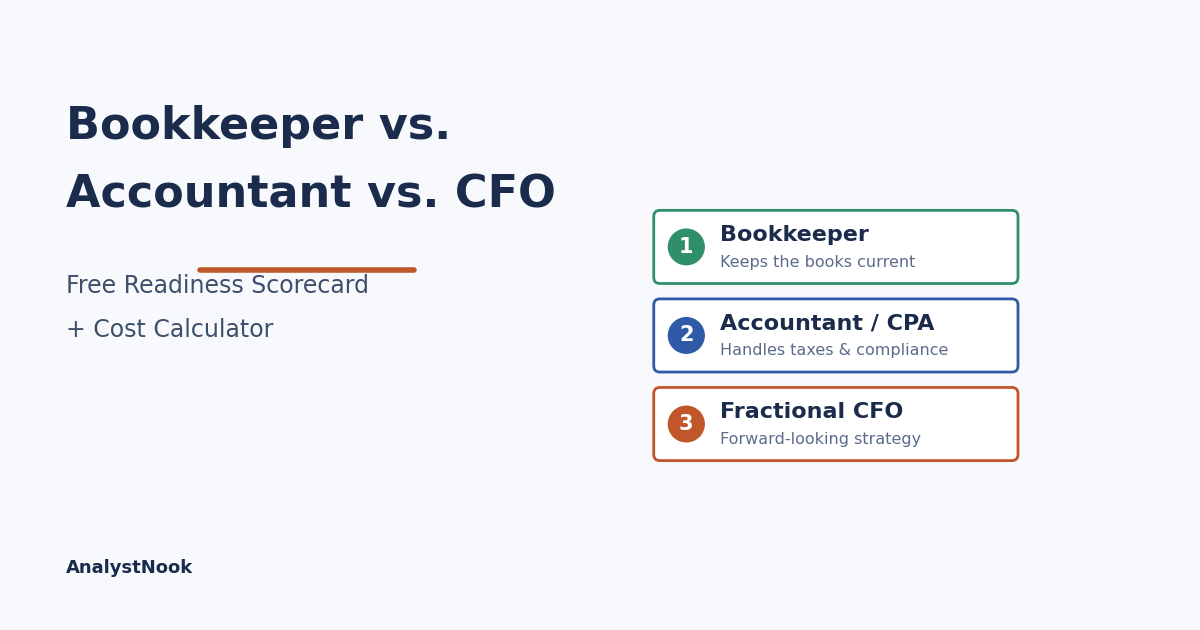
A bookkeeper records what already happened: categorizing transactions, reconciling bank accounts, running payroll, and keeping your books current. It’s operational and backward-looking — the goal is accurate historical records, not advice.
An accountant (or CPA) interprets those records for compliance and tax purposes: preparing and filing tax returns, ensuring you’re following accounting rules correctly, and advising on tax strategy. Where a bookkeeper keeps the books current, an accountant makes sure they hold up to the IRS and translate into a correct return.
A CFO (almost always fractional or outsourced for a small business) is forward-looking: cash flow forecasting, pricing strategy, fundraising and lender conversations, and translating the numbers into decisions about hiring, growth, and risk. A CFO uses the bookkeeper’s records and the accountant’s compliance work as raw material — they don’t replace either one.
Signs You Need a Bookkeeper
If you’re spending more than a few hours a month on data entry, reconciling accounts, or realize your books are more than a month behind, that’s the clearest signal. Other signs: you can’t say what you made last month without digging, you’ve missed a bill or double-paid an invoice because nothing was tracked centrally, or tax season turns into a weeks-long reconstruction project. This is usually the first hire, and often the cheapest — many businesses outsource it for a few hundred dollars a month before they need anything else.
Signs You Need an Accountant (or CPA)
Nearly every business eventually needs one at tax time, but the earlier signal is complexity: you’ve formed an LLC or corporation, you have employees and payroll tax obligations, you’re not sure whether you’re structured optimally for taxes, or you’ve had a scare — a notice from the IRS, an audit, or a filing you weren’t confident about. An accountant is also the right call before a major decision with tax consequences: selling the business, taking on an investor, or a large asset purchase.
Signs You Need a CFO
This is usually the latest hire, and the one most small businesses delay past the point they actually needed it. The signals: you’re making six-figure decisions (hiring, a lease, a big purchase) without a clear read on whether you can afford them; you’re raising money or applying for a loan and need projections a lender will trust; cash is confusing even though the business is profitable on paper; or you’ve simply outgrown “I’ll figure out the numbers myself” and need someone thinking about the finance function full-time, even if only a few hours a week. A fractional CFO fills this need without the six-figure salary of a full-time hire.
What Each One Actually Costs
Rough ranges, since they vary by location, industry, and complexity:
- Bookkeeper: $300–$800/month for outsourced part-time bookkeeping on a small business’s volume of transactions, or $20–$50/hour if billed hourly. A full-time in-house bookkeeper runs $45,000–$60,000/year.
- Accountant/CPA: $500–$2,000 for annual tax preparation depending on complexity, or $150–$400/hour for advisory work outside of tax season. Some offer monthly packages combining light bookkeeping oversight with tax planning.
- Fractional CFO: $2,000–$10,000+/month depending on hours and scope, versus $150,000–$250,000+/year for a full-time CFO. Most small businesses only need a few hours a week, which is exactly what the fractional model is built for.
The pattern across all three: outsourced and fractional arrangements exist specifically so a small business can access the skill without the full-time cost — you’re very rarely choosing between “hire full-time” and “go without.”
You Don’t Have to Choose Just One
This isn’t a ladder where you graduate from one to the next. A healthy small business finance setup is often layered: a bookkeeper keeping daily records current, a CPA handling taxes and structure once or twice a year, and a fractional CFO engaged periodically — around a fundraise, a big hiring decision, or a planning cycle — rather than continuously — a transition SCORE covers in more detail in its own guide to moving between these roles. The bookkeeper vs accountant question especially rarely has a single right answer — the real question isn’t “which one,” it’s “which ones, and how much of each, right now.”
What’s Inside the Free Readiness Scorecard + Cost Calculator
The download below has two working tabs. The Readiness Scorecard tab walks through the signals above as a checklist across all three roles — check off what’s true for your business, and it tells you which role (or roles) you’re likely ready for right now. The Cost Calculator tab lets you estimate a realistic monthly cost for outsourced bookkeeping, accounting, and fractional CFO support based on your business’s size and complexity, so you can budget before you start calling around.
How to Use It
Start with the Readiness Scorecard and answer honestly rather than aspirationally — the point is where your business actually is today, not where you want it to be. Then use the Cost Calculator to get a realistic monthly range for whichever roles the scorecard points to, so you’re not caught off guard by the first quote you get, whichever side of the bookkeeper vs accountant line your business currently sits on.
Frequently Asked Questions
Can one person do more than one of these roles?
Sometimes, especially early on — a bookkeeper with strong QuickBooks skills can handle basic reconciliation and light reporting, and some CPAs offer bookkeeping as part of a package. But be cautious about asking one person to do all three well: bookkeeping, tax compliance, and forward-looking strategy require different skills, and a generalist is rarely excellent at all three at once — which is exactly why the bookkeeper vs accountant distinction matters even when one person is covering both for now.
Is a controller the same as a CFO?
No, though they’re often confused. A controller sits between an accountant and a CFO — they own the accuracy of the books and internal financial processes, but typically don’t do the strategic, forward-looking work (fundraising, high-level forecasting, board-level advising) that a CFO does. Most small businesses skip the controller title entirely and go from bookkeeper straight to a fractional CFO when they need that strategic layer — the bookkeeper vs accountant vs CFO question rarely includes “controller” as a fourth option in practice.
Should I hire in-house or outsource?
For a bookkeeper or CFO, outsourced/fractional is almost always the better starting point for a small business — you get the skill at a fraction of the full-time cost, and can scale hours up as you grow. In-house makes more sense once your transaction volume or complexity genuinely requires someone full-time, which for most small businesses comes later than owners expect — outsourcing is also the lower-risk way to test the bookkeeper vs accountant split before committing to a full-time hire.
What’s the biggest mistake business owners make with this decision?
Waiting for a crisis to force the hire, rather than recognizing the signals early — the bookkeeper vs accountant decision especially gets put off too long. A missed tax deadline, a loan application you can’t support with real numbers, or a cash crunch you didn’t see coming are all more expensive — in money, stress, and lost opportunities — than the cost of getting ahead of it with the right help sooner.
How do I know if a fractional CFO is worth the cost?
Compare the cost against the size of the decisions they’d influence. If you’re about to make a hiring decision, take on debt, or raise money — decisions worth tens or hundreds of thousands of dollars — a few thousand dollars a month for someone to stress-test those numbers is usually cheap insurance, not an expense.
Download the Free Readiness Scorecard + Cost Calculator
Want new templates emailed to you?
No spam. Unsubscribe anytime. Downloads never require this.
Whichever role you bring in, they’ll need clean inputs to work with — our guides on financial document management and unit economics cover the records and per-sale numbers a bookkeeper, accountant, or CFO will all ask about first. And if you want to understand the bigger picture a CFO builds toward, our financial modeling guide walks through building a full model from scratch.
