
Cash sitting in inventory is cash that isn’t doing anything else for your business. This inventory turnover ratio calculator measures how many times you sell through and replace your inventory over a period — and it’s one of the clearest signals of whether your purchasing and your sales are actually in sync.
I’ve seen businesses with healthy revenue quietly starve their cash flow because inventory was piling up faster than it sold. This calculator gives you the number in about thirty seconds, along with what a healthy range looks like for your kind of business.
What Is Inventory Turnover Ratio?
Inventory Turnover Ratio measures how many times your average inventory balance is sold and replaced during a period, usually a year. It’s calculated as Cost of Goods Sold divided by Average Inventory.
A related metric, Days Inventory Outstanding (DIO), converts the ratio into days — how long, on average, a unit sits in inventory before it sells. The two move in opposite directions: higher turnover means lower DIO.
The Inventory Turnover Formula
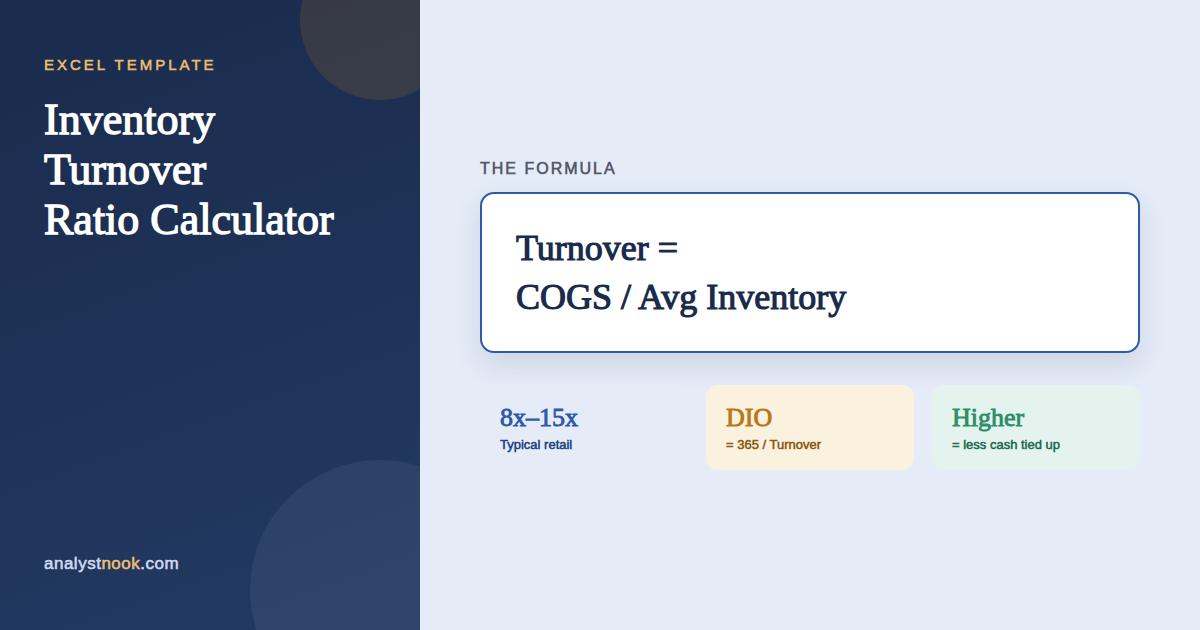
Turnover equals COGS divided by Average Inventory (the average of your beginning and ending inventory balances for the period). Days Inventory Outstanding is simply the number of days in your period divided by the turnover ratio.
How to Calculate Inventory Turnover Step by Step
- Pull your Cost of Goods Sold for the period from your income statement — use COGS, not revenue.
- Find your beginning and ending inventory balances (at cost) for the same period from your balance sheet.
- Average the two inventory balances.
- Divide COGS by average inventory for your turnover ratio.
- Divide days in the period (365 for a full year) by the turnover ratio for Days Inventory Outstanding.
A Worked Example
Say your annual COGS is $480,000, beginning inventory was $58,000, and ending inventory is $62,000. Average inventory is $60,000, so turnover = $480,000 ÷ $60,000 = 8.0x.
Days Inventory Outstanding = 365 ÷ 8.0 = about 45.6 days — meaning, on average, inventory sits for a little over six weeks before it sells.
Common Mistakes to Avoid
Inventory turnover is easy to calculate but easy to misread without context. Watch for these:
- Using revenue instead of COGS. Revenue includes markup; COGS reflects what the inventory actually cost you — using revenue overstates turnover.
- Comparing across unrelated industries. Grocery and fashion retail can run 10x+ turnover; heavy equipment or furniture may run under 3x — “normal” is industry-specific.
- Ignoring seasonality. A single snapshot of beginning/ending inventory can be misleading if your business has strong seasonal swings — consider using a monthly average instead.
- Treating higher as always better. Extremely high turnover can mean you’re understocking and losing sales to stockouts, not just running lean.
- Not tracking the trend. A single period’s ratio matters less than whether it’s rising or falling quarter over quarter.
How to Use the Excel Template
- Enter your period’s Cost of Goods Sold in the yellow cell.
- Enter your beginning and ending inventory balances for the same period.
- Read your Inventory Turnover Ratio and Days Inventory Outstanding in the results panel, along with the benchmark guide.
Download the Free Inventory Turnover Ratio Calculator
Download the free Inventory Turnover Ratio Calculator below — no email signup required.
Want new templates emailed to you?
No spam. Unsubscribe anytime. Downloads never require this.
Need this template customized to your business — a different setup, extra categories, or your own formulas built in? Email me at sharafudin1999@gmail.com or drop a comment below and I’ll help you tweak it.
If turnover is falling, the next place to look is your ordering and collections cycle — our Accounts Payable Aging Report and Working Capital Calculator both help pinpoint where cash is getting stuck.
For more on how this ratio is used across industries, see Corporate Finance Institute‘s overview of inventory turnover, the same metric this inventory turnover ratio calculator computes.
Frequently Asked Questions
What is a good inventory turnover ratio?
It varies widely by industry — grocery and fast fashion often run 8x–15x or higher, while furniture, heavy equipment, or luxury goods can be healthy at 2x–4x. Compare your ratio to others in your specific industry rather than a universal benchmark.
What does a low inventory turnover ratio mean?
A low or declining ratio often signals overstocking, slow-moving or obsolete inventory, or weakening demand — all of which tie up cash that could otherwise be used elsewhere in the business.
How is Days Inventory Outstanding different from turnover ratio?
They’re two views of the same underlying data. Turnover ratio tells you how many times inventory cycles per year; DIO translates that into the average number of days a unit sits before selling. Lower DIO corresponds to higher turnover.
Should I use COGS or average inventory cost for this calculation?
Use COGS from your income statement for the numerator, and the average of your beginning and ending inventory balances (both valued at cost, not retail price) for the denominator.
How often should I calculate inventory turnover?
Monthly or quarterly is ideal for catching problems early, especially if your business carries meaningful inventory. At minimum, calculate it annually alongside your other financial statement analysis.
