
A business can be profitable on paper and still run out of cash to pay its bills — that’s the gap working capital measures. It’s not about whether you’re making money over the year; it’s about whether you have enough cash and near-cash resources on hand right now to cover what comes due in the next few months. A lot of small business owners only discover their working capital is thin when a supplier payment and a slow month collide at the same time.
The free working capital calculator below does the math for you: enter your current assets and current liabilities, and it returns your net working capital, your working capital ratio, and a quick ratio — plus a 12-month tracker so you can watch the trend instead of checking it once and forgetting about it.
What’s Inside the Free Working Capital Calculator
The download is a single Excel file with two tabs. The first is the calculator itself: enter cash, accounts receivable, inventory, and prepaid expenses as your current assets, then accounts payable, short-term debt, and accrued expenses as your current liabilities. It returns your net working capital in dollars, your working capital ratio, your quick ratio (which excludes inventory), and a plain-language read on what your ratio actually means. The second tab is a 12-month trend tracker with a built-in chart, so you can log your totals every month and watch whether your cushion is growing, shrinking, or holding steady.
Understanding Working Capital
What Working Capital Actually Measures
Working capital measures liquidity, not profitability. It answers one specific question: if every current liability came due today, could your current assets cover it? Current assets are cash and anything that will reasonably turn into cash within a year — cash itself, money customers owe you, inventory you expect to sell. Current liabilities are what you owe within that same window — supplier bills, short-term loan payments, payroll taxes accrued but not yet paid. Working capital is simply the difference between the two.
Why It Matters More Than Profit
Profit is an accounting figure measured over a period — a month, a quarter, a year. Cash doesn’t arrive on that same schedule. A business can book a large profitable sale and still be unable to make payroll next week, because the sale is sitting in accounts receivable rather than in the bank. Working capital is the number that tells you whether the timing works, which is exactly the kind of problem a P&L was never designed to catch. If you haven’t already, it’s worth pairing this calculator with our Profit and Loss Statement Template — the P&L shows whether the business is profitable, and working capital shows whether it can survive the gap between earning the money and collecting it.
The Working Capital Formula, Step by Step
The calculation itself is simple arithmetic. The work is in classifying your accounts correctly before you subtract.
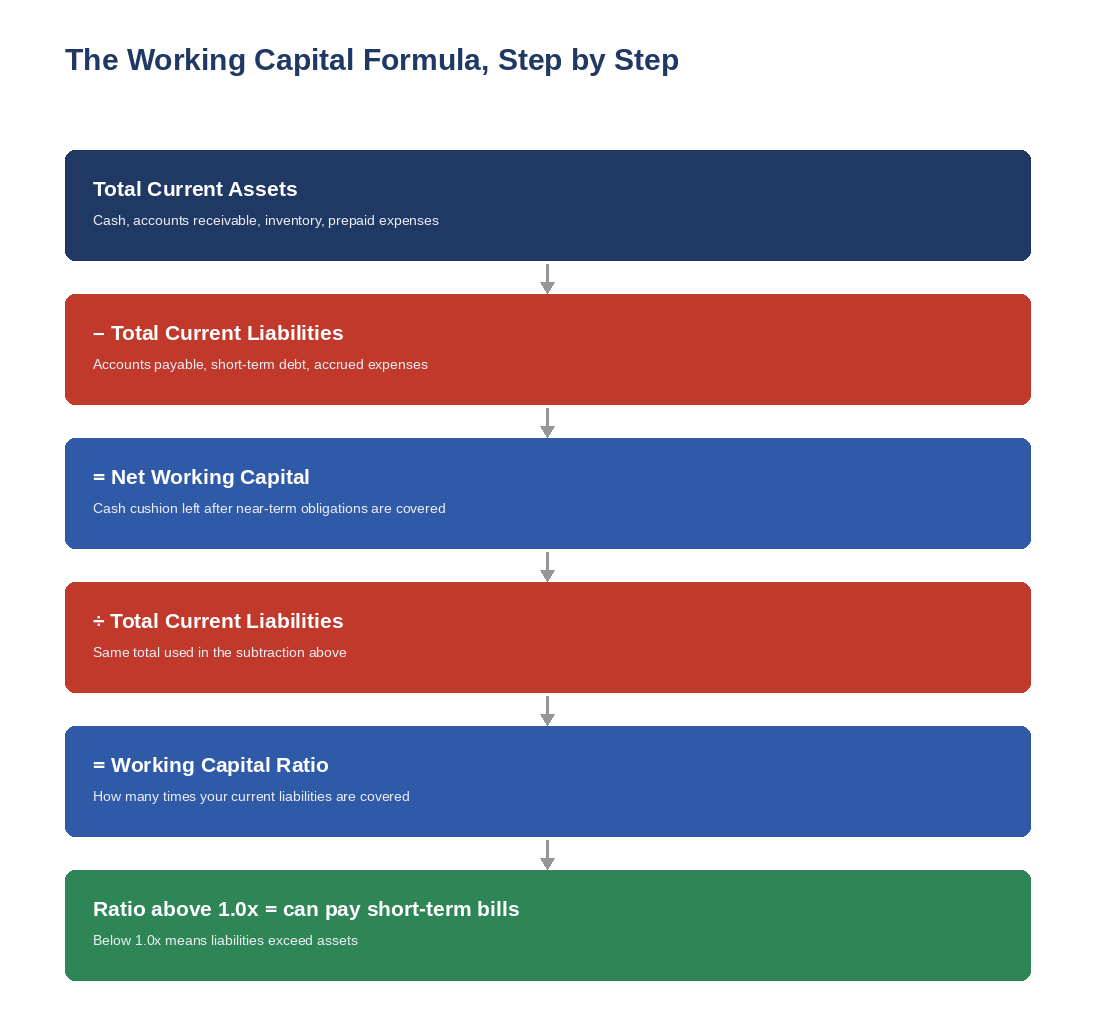
Current Assets
Cash and cash equivalents, accounts receivable (what customers owe you), inventory on hand, and prepaid expenses or other assets you expect to use or convert to cash within twelve months. Anything you won’t touch for years — equipment, a building, a long-term investment — doesn’t belong here even though it’s technically an asset.
Current Liabilities
Accounts payable, the current portion of any loan (the part due within a year, not the whole balance), accrued wages and taxes, and any other bill or obligation coming due within twelve months. A five-year equipment loan isn’t a current liability in full — only the next twelve months of payments on it are.
Net Working Capital
Total current assets minus total current liabilities. A positive number means you have more short-term resources than short-term obligations. A negative number means the reverse is true — current liabilities exceed current assets — which is a warning sign worth investigating immediately, not a footnote.
Working Capital Ratio
Current assets divided by current liabilities, expressed as a multiple. A ratio of 1.5x means you have $1.50 in current assets for every $1.00 you owe in the next twelve months. It’s often more useful than the dollar figure alone, because it scales — $50,000 of net working capital means something very different for a business with $60,000 in current liabilities than one with $600,000.
Methods of Calculating Working Capital
Net working capital and the working capital ratio are the two numbers most small businesses need, but there are a couple of variations worth knowing.
Net working capital is the dollar-amount cushion: current assets minus current liabilities. It’s the most direct answer to “how much breathing room do we have.”
The working capital ratio (current ratio) is net working capital expressed as a multiple instead of a dollar figure, which makes it easier to compare across time or against other businesses regardless of size.
The quick ratio (also called the acid-test ratio) is the more conservative version — it removes inventory from current assets before dividing, because inventory is the current asset least likely to convert to cash quickly if you actually needed it to. A business with a healthy current ratio but a weak quick ratio usually has too much cash tied up sitting on shelves.
Operating working capital is a variation used more in larger-company finance: it excludes cash and short-term debt from the calculation, isolating the working capital that’s tied directly to day-to-day operations (receivables, inventory, and payables). Most small businesses don’t need this version, but it’s worth knowing the term if you ever see it in a lender’s or investor’s request.
Analyzing Your Working Capital Needs
How much working capital you actually need depends heavily on your business model, not on a universal target. A seasonal business — landscaping, holiday retail, tax preparation — needs to build a larger cushion during its strong months specifically because it knows the lean months are coming and current liabilities don’t pause just because revenue does. A business with fast-paying customers and slow-paying suppliers can run comfortably on a thinner margin than one that waits sixty days to get paid while its own bills are due in fifteen.
Growth can also strain working capital in a way that surprises new owners: taking on more customers usually means carrying more receivables and more inventory before the cash from that growth actually lands in the bank. A business can be growing quickly and getting shorter on cash at the same time — it’s one of the more common ways a fast-growing small business runs into a liquidity crunch that has nothing to do with whether the growth itself is profitable.
There’s also such a thing as too much working capital. A very high ratio can mean cash is sitting idle in a checking account, or that inventory is overstocked, rather than being put to work paying down debt, reinvesting in the business, or earning a return elsewhere. The goal isn’t to maximize the ratio — it’s to keep enough cushion to operate safely without leaving money parked and unproductive.
Common Working Capital Mistakes Small Business Owners Make
Including long-term debt in the calculation. Only the portion of a loan due within the next twelve months counts as a current liability. Dropping the entire loan balance in will understate your working capital and make a perfectly healthy business look distressed — always feed the working capital calculator the current-portion figure your accountant uses, not the full loan balance.
Treating all inventory as equally liquid. Slow-moving or obsolete inventory counts as a current asset on paper, but it may not convert to cash anywhere near as fast as the calculation assumes. This is exactly why the quick ratio exists as a second check.
Calculating it once and moving on. Working capital shifts every month as receivables are collected, bills are paid, and inventory turns over. A number from six months ago tells you almost nothing about your position today.
Ignoring the receivables side. A healthy working capital ratio built on receivables that are actually 90 days overdue isn’t as healthy as it looks. It’s worth checking the age of your receivables alongside the ratio itself, not just the total.
Confusing working capital with cash on hand. Working capital includes receivables and inventory that haven’t converted to cash yet. A business can have strong working capital and still face a real cash shortfall this week if too much of that cushion is tied up in unpaid invoices.
How to Use It
Pull your current asset and current liability totals from your latest balance sheet — if you don’t have one built already, our Balance Sheet Template will get you there in a few minutes. Enter the four asset lines and four liability lines into the calculator tab, and it returns your net working capital, current ratio, and quick ratio immediately. Then move to the 12-Month Trend tab and log the same two totals every month — the single-month snapshot tells you where you stand today, but the trend line is what actually warns you if your cushion is quietly shrinking before it becomes a real problem.
Frequently Asked Questions
What’s a good working capital ratio for a small business?
Most small businesses aim for somewhere between 1.2x and 2.0x. Below 1.0x means current liabilities exceed current assets, which is a genuine warning sign. Above roughly 2.0x isn’t dangerous, but it can mean cash or inventory is sitting idle instead of being put to productive use. This ratio is closely related to what’s often called the current ratio in accounting terminology, though a working capital calculator gives you the dollar amount rather than just the ratio.
What’s the difference between working capital and cash flow?
Working capital is a snapshot — current assets minus current liabilities at a single point in time. Cash flow is a movement — how much cash actually came in and went out over a period. A business can have positive working capital and still experience negative cash flow in a given month, and the two are worth tracking side by side rather than treating as interchangeable. Running both through a working capital calculator and a cash flow forecast is the most reliable way to catch a timing mismatch before it becomes a crisis.
Can working capital be negative?
Yes, and for most small businesses it’s a real problem — it means current liabilities exceed current assets, so covering next month’s obligations depends on new sales landing exactly on time. A handful of business models (some subscription and retail businesses that collect cash from customers well before paying suppliers) can operate with negative working capital by design, but that’s the exception, not something to assume applies to you. If you’re not sure which camp your business falls into, a working capital calculator run monthly for a quarter will make the pattern obvious.
How often should I calculate working capital?
Monthly is the practical minimum for most small businesses, and it’s exactly why the calculator includes a 12-month tracking tab rather than just a single-entry calculator. A seasonal or fast-growing business may want to check it more often, especially heading into a known slow period. Bookmarking a working capital calculator and rerunning it on the same schedule as your other financial reviews keeps this from slipping.
My working capital ratio is below 1.0x. What should I do first?
Start with receivables — collecting faster is usually quicker to fix than any other lever. Check how much is overdue and follow up on the oldest invoices first. From there, look at whether inventory is overstocked and could be reduced, and whether any current liability could reasonably be renegotiated or extended. Cutting costs helps profit, but it’s the speed of cash coming in and going out that fixes working capital specifically. Re-run the working capital calculator after each fix to confirm the ratio is actually moving in the right direction.
Download the Free Working Capital Calculator
Download the free Working Capital Calculator below — no email signup required. It’s pre-loaded with sample numbers so you can see exactly how it works before you clear it out and enter your own.
Want new templates emailed to you?
No spam. Unsubscribe anytime. Downloads never require this.
Looking for more small business finance tools? Check out our Balance Sheet Template, Cash Flow Forecast Template, Break-Even Calculator, and our Profit and Loss Statement Template.
