
You can be profitable on paper and still run out of cash. It happens more often than most small business owners expect: invoices sit unpaid for weeks, a big supplier payment lands before the matching sale gets collected, or a slow season eats into a cushion that looked fine on the P&L. A cash flow statement is the tool that reconciles the two. It shows exactly where your cash came from and where it went, separate from when the revenue and expenses were recorded.
This free cash flow statement template uses the indirect method, the format almost every lender, investor, and accountant expects to see. Instead of tracking every individual cash receipt and payment, it starts from your net income and adjusts for the items that separate profit from cash: depreciation, and the timing gap created by receivables, inventory, and payables. Enter your numbers once a month and every subtotal, operating, investing, financing, and your ending cash balance, recalculates on its own.
What’s Inside the Free Cash Flow Statement Template
The download is a single Excel file with three tabs. A Working Capital Schedule is where you enter your Accounts Receivable, Inventory, Accounts Payable, and Accrued Liabilities balances for each month; it calculates the month-over-month change for you, with the sign already flipped correctly for cash flow. The Cash Flow Statement tab is the indirect-method statement itself, with sections for operating, investing, and financing activities that pull those changes in automatically. An Annual Summary tab rolls the year into one view, including your lowest projected cash balance and how many months (if any) would run negative.
The workbook comes pre-loaded with a full year of sample data from a small product-and-service business, so you can see exactly how the formulas behave before clearing them out and entering your own numbers. Every subtotal and the ending cash balance is a formula, you only ever type into the shaded, blue-text cells.
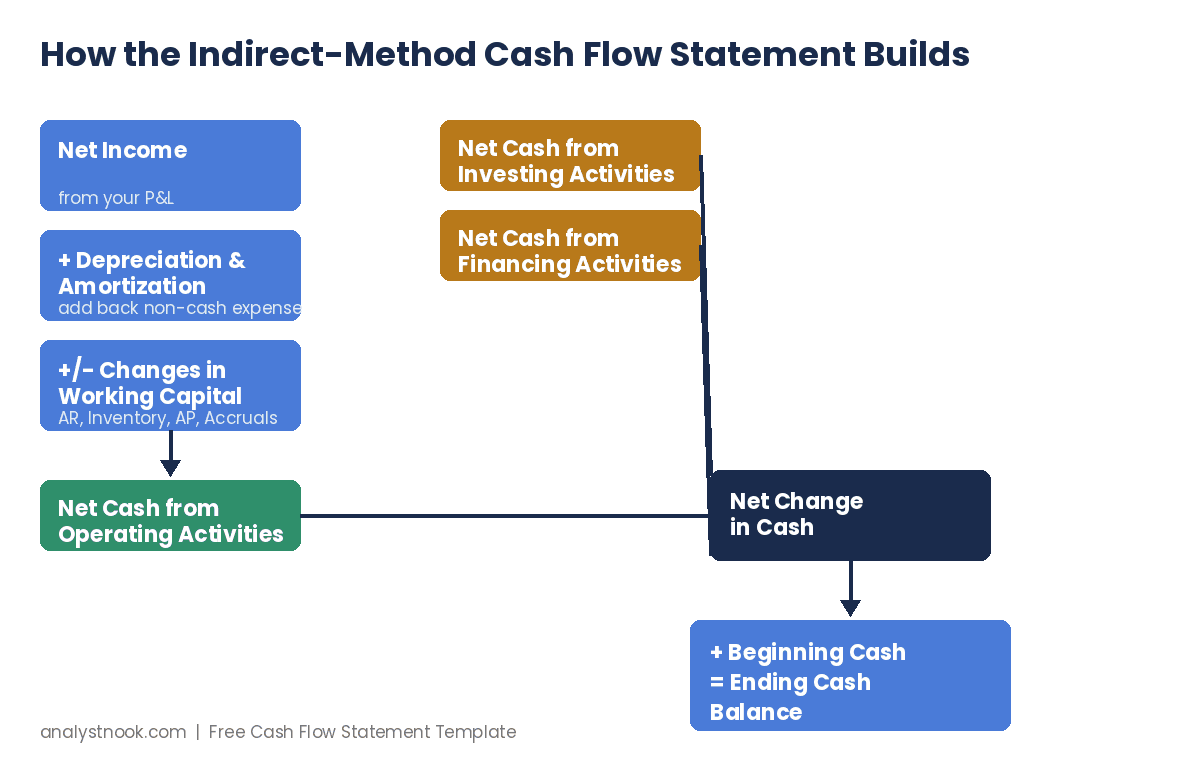
Understanding the Indirect-Method Cash Flow Statement
Every cash flow statement built on the indirect method moves through the same three sections, in the same order. Each one answers a different question about where your cash actually went.
Operating Activities
This section starts with net income, then adjusts it for everything that separates profit from cash. Depreciation and amortization get added back because they reduce net income without ever costing you cash. Then come the working capital adjustments: an increase in Accounts Receivable subtracts cash, because it means you booked revenue you haven’t collected yet. An increase in Inventory subtracts cash for the same reason, you paid for stock that hasn’t sold. An increase in Accounts Payable or Accrued Liabilities adds cash back, because it means you’re holding onto cash a little longer before paying a bill you’ve already recorded. The result is Net Cash from Operating Activities: the cash your actual operations generated, stripped of accrual-accounting timing.
Investing Activities
This section captures cash spent on or received from long-term assets: buying equipment, a vehicle, or software you’ll depreciate over several years, and any proceeds from selling an asset you no longer need. Most small businesses see this section stay negative in growth periods, spending on equipment is normal, and it’s worth watching in isolation from operating cash so a big purchase doesn’t get mistaken for an operating problem.
Financing Activities
This section covers cash moving between the business and its owners or lenders: loan proceeds and repayments, owner contributions, and owner draws or distributions. A business can look perfectly healthy on operating cash flow and still be draining its bank account if draws or loan payments in this section outpace what operations bring in, which is exactly why the three sections are kept separate instead of blended into one number.
Net Change in Cash and Ending Balance
Add the three section totals together and you get the Net Change in Cash for the month. Add that to your Beginning Cash Balance, your actual bank balance on day one of the period, and you get the Ending Cash Balance. In the template, each month’s beginning balance carries forward automatically from the prior month’s ending balance, so you only ever enter your starting cash once, in the very first month.
A Worked Cash Flow Statement Example
Say a small landscaping business closes March with $9,500 of net income on its P&L. Equipment depreciation for the month is $600, so that gets added back first: $9,500 plus $600 equals $10,100. Accounts Receivable rose by $1,300 during the month, since a few larger jobs were invoiced but not yet paid, so that subtracts $1,300. Inventory of supplies dropped by $300 as older stock got used up, which adds $300 back. Accounts Payable rose by $700 because a fuel bill was pushed to the following month, adding another $700. Net Cash from Operating Activities comes out to $9,800, lower than net income, but not by much.
That same month, the business bought a used trailer for $3,500, which is a $3,500 outflow in Investing Activities. On the financing side, it made a $450 loan payment and the owner took a $2,000 draw, for a $2,450 outflow in Financing Activities. Add the three sections together: $9,800 minus $3,500 minus $2,450 leaves a Net Change in Cash of $3,850 for the month. If the bank balance was $18,000 on March 1st, the Ending Cash Balance is $21,850, a number the owner can check directly against the actual bank statement to confirm the statement is built correctly.
Notice that net income ($9,500) and the ending change in cash ($3,850) tell two different stories. Neither one is wrong, they’re just answering different questions. Net income says the business was profitable. The cash flow statement says less of that profit is sitting in the bank than the P&L alone would suggest, once a growing receivables balance and an equipment purchase are accounted for.
Why Lenders and Investors Ask for a Cash Flow Statement
A profit and loss statement can be flattering in ways a cash flow statement can’t. A business can report strong net income for months while its receivables quietly balloon and its actual cash position deteriorates, which is precisely the scenario a lender is trying to catch before extending credit. The cash flow statement is what shows whether a business generates enough cash from its own operations to cover debt payments, rather than relying on financing or draining a cash cushion to stay afloat.
Most lenders will ask for 12 months of cash flow statements alongside your P&L and balance sheet, particularly for a loan large enough to require underwriting rather than an automatic approval. Investors ask for the same reason: operating cash flow is one of the clearest signals of whether a business’s growth is self-funding or dependent on outside capital to keep the lights on. Building this monthly, rather than assembling twelve months of it right before a loan application, means the numbers are already accurate and the schedule is already reconciled to your actual bank statements.
Direct vs. Indirect Method: Which Should You Use
The direct method lists actual cash receipts and payments, cash collected from customers, cash paid to suppliers, cash paid for payroll, added and subtracted line by line. It’s intuitive to read, but building it requires pulling cash-basis data most small business accounting systems don’t track cleanly, since QuickBooks, Xero, and similar software are built around accrual entries.
The indirect method, the format this template uses, starts from net income, a number you already have on your profit and loss statement, and reconciles it to cash through a short list of adjustments. It takes a fraction of the time to build, it’s the format almost every lender and accountant expects, and it has the added benefit of showing you exactly how profit and cash diverge, which is usually the more useful question anyway.
Cash Flow Statement vs. Cash Flow Forecast vs. Profit and Loss Statement
These three reports get mixed up constantly, and the difference matters more than the names suggest. A cash flow statement looks backward: it records what actually happened to your cash during a period that’s already closed, as Investopedia’s definition of the cash flow statement confirms. A cash flow forecast looks forward: it projects what your cash balance will be in future weeks or months based on expected receipts and payments, so you can catch a shortfall before it happens rather than explain it after. If planning ahead is what you need, our Cash Flow Forecast Template is built specifically for that.
A profit and loss statement is different again: it measures profitability on an accrual basis, recording revenue and expenses when they’re earned or incurred rather than when the cash moves. That’s exactly the gap the cash flow statement’s working-capital adjustments exist to close. If you haven’t built this month’s P&L yet, our Profit and Loss Statement Template is the natural starting point, its net income figure is the first line of this cash flow statement.
Common Cash Flow Statement Mistakes Small Business Owners Make
A few habits show up often enough that they’re worth calling out directly.
- Confusing profit with cash. A business can show a healthy net income and still bounce a payroll check, because revenue on the P&L doesn’t mean the cash has arrived. The cash flow statement exists specifically to catch this before it becomes a crisis.
- Skipping the working capital adjustments. It’s tempting to treat net income as close enough to cash flow and skip the Accounts Receivable, Inventory, and Accounts Payable lines entirely. For a business with any real receivables or inventory, that gap can be large enough to hide a genuine cash problem.
- Lumping a big one-time purchase into operating expenses. Buying a piece of equipment is an investing activity, not an operating one. Mixing it in makes your operating cash flow look worse than your actual operations are performing, and hides the real trend from month to month.
- Only building one at tax time. A cash flow statement that’s twelve months stale can’t help you catch a shortfall while it’s still avoidable. Monthly is the right cadence for most small businesses.
- Ignoring owner draws when cash gets tight. Draws and distributions sit in the financing section for a reason, they’re optional, discretionary cash outflows. When operating cash flow turns thin, that’s the first line worth revisiting, and it’s easy to miss if you’re only looking at the bottom line.
What to Do When the Statement Shows a Cash Shortfall
If the Annual Summary tab flags a month where projected cash would run negative, the fix depends on which section is driving it. A shortfall coming from Operating Activities usually means receivables are stretching out or inventory is building up faster than sales, worth a direct conversation with slow-paying customers, or tightening payment terms on new invoices going forward. A shortfall driven by Investing Activities is often a timing choice: a planned equipment purchase can sometimes move a month or two without real cost, just by checking the projected balance first.
A shortfall from Financing Activities is the one worth catching earliest, since it usually means loan payments and owner draws together are outpacing what the business generates on its own. That’s not automatically a problem in a single month, but if it repeats for two or three months in a row, it’s a sign the draw amount or the loan structure needs revisiting before the cash cushion runs out rather than after.
How to Use It Every Month
Update the Working Capital Schedule tab first: enter your ending Accounts Receivable, Inventory, Accounts Payable, and Accrued Liabilities balances for the month, pulled from your balance sheet or accounting software. Then enter net income and depreciation on the Cash Flow Statement tab, net income comes straight from your P&L. Add any equipment purchases, loan activity, or owner draws for the month. Everything else, including the working capital changes, the three section totals, and your ending cash balance, calculates on its own.
Set a recurring reminder for the same day each month, right after you close the books on your P&L is usually the easiest time, since net income and the balance sheet figures are already fresh. Keeping one workbook per calendar year, rather than overwriting the same file indefinitely, also makes it easy to compare this March against last March once you have more than one year on file.
Then spend two minutes reading it: check the Annual Summary tab for your lowest projected cash balance and confirm it never goes negative. If operating cash flow is consistently lower than net income, your receivables or inventory are likely growing faster than your sales, worth investigating while it’s still a small gap.
Frequently Asked Questions
What’s the difference between a cash flow statement and a cash flow forecast?
A cash flow statement records what already happened to your cash during a period that’s closed. A cash flow forecast projects what your cash balance will be in future periods based on expected activity. Most small businesses benefit from having both: the statement shows you the actual trend, and the forecast helps you plan around it.
Why does the indirect method start with net income instead of cash receipts?
Because net income is a number nearly every small business already has from its P&L or accounting software, while cash receipts and payments by category usually aren’t tracked separately. Starting from net income and adjusting for the handful of items that differ from cash is far faster to build and is the format lenders and accountants expect to see.
Why does an increase in Accounts Receivable subtract from cash flow?
Because that revenue was already counted in net income, but the cash for it hasn’t arrived yet. Subtracting the increase removes revenue that exists on paper but not yet in the bank, which is exactly what a cash flow statement is meant to show.
How often should I build a cash flow statement?
Monthly, for most small businesses. It’s frequent enough to catch a cash trend, receivables stretching out, inventory building up, while it’s still a small and manageable problem, without turning into unnecessary overhead.
My cash flow statement shows negative operating cash flow, but I’m profitable. What does that mean?
It usually means your receivables or inventory are growing faster than your sales, or you’re paying suppliers faster than customers are paying you. It’s not automatically a crisis, but it’s worth investigating quickly, a business can be profitable on paper for months while its cash position quietly deteriorates.
Download the Free Cash Flow Statement Template
Download the free Cash Flow Statement Template below, no email signup required. It’s pre-loaded with a full year of sample data so you can see exactly how the formulas work before you clear it out and enter your own numbers.
Want new templates emailed to you?
No spam. Unsubscribe anytime. Downloads never require this.
Looking for more small business finance tools? Check out our Profit and Loss Statement Template, our Cash Flow Forecast Template, and our Balance Sheet Template. If you’re comparing this month against a plan, pair it with our Budget vs. Actual Analysis. And to see your P&L, balance sheet, and cash flow linked together in one model, check out our 3-Statement Financial Model Template.
