
“What’s my business worth?” comes up for a lot of reasons — a potential sale, bringing on a partner, a divorce or estate matter, or just wanting a real number instead of a guess. There’s no single official answer, but there is a standard, defensible method small business owners and buyers actually use, and it doesn’t require hiring an appraiser to get a solid starting estimate. Learning how to value a small business starts with one number: your Seller’s Discretionary Earnings.
The free valuation calculator below walks through that method from start to finish. Enter your net income and a handful of add-backs, apply an industry multiple, and it produces a valuation range — cross-checked against your asset value and revenue — so you’re not relying on a single number that could be wrong in either direction.
What’s Inside the Free Small Business Valuation Calculator
The download is a single Excel file, pre-loaded with sample numbers so you can see how it behaves before entering your own. It calculates your Seller’s Discretionary Earnings (SDE), applies a low-to-high industry multiple to get an SDE-based valuation range, cross-checks that against an asset-based floor value and a revenue-multiple estimate, and rolls all three into a single weighted valuation you can adjust. A built-in chart shows how much your estimated value shifts as the multiple moves.
How to Value a Small Business, Step by Step
Business valuation sounds complicated mostly because of the vocabulary. The actual process is a short, ordinary sequence.
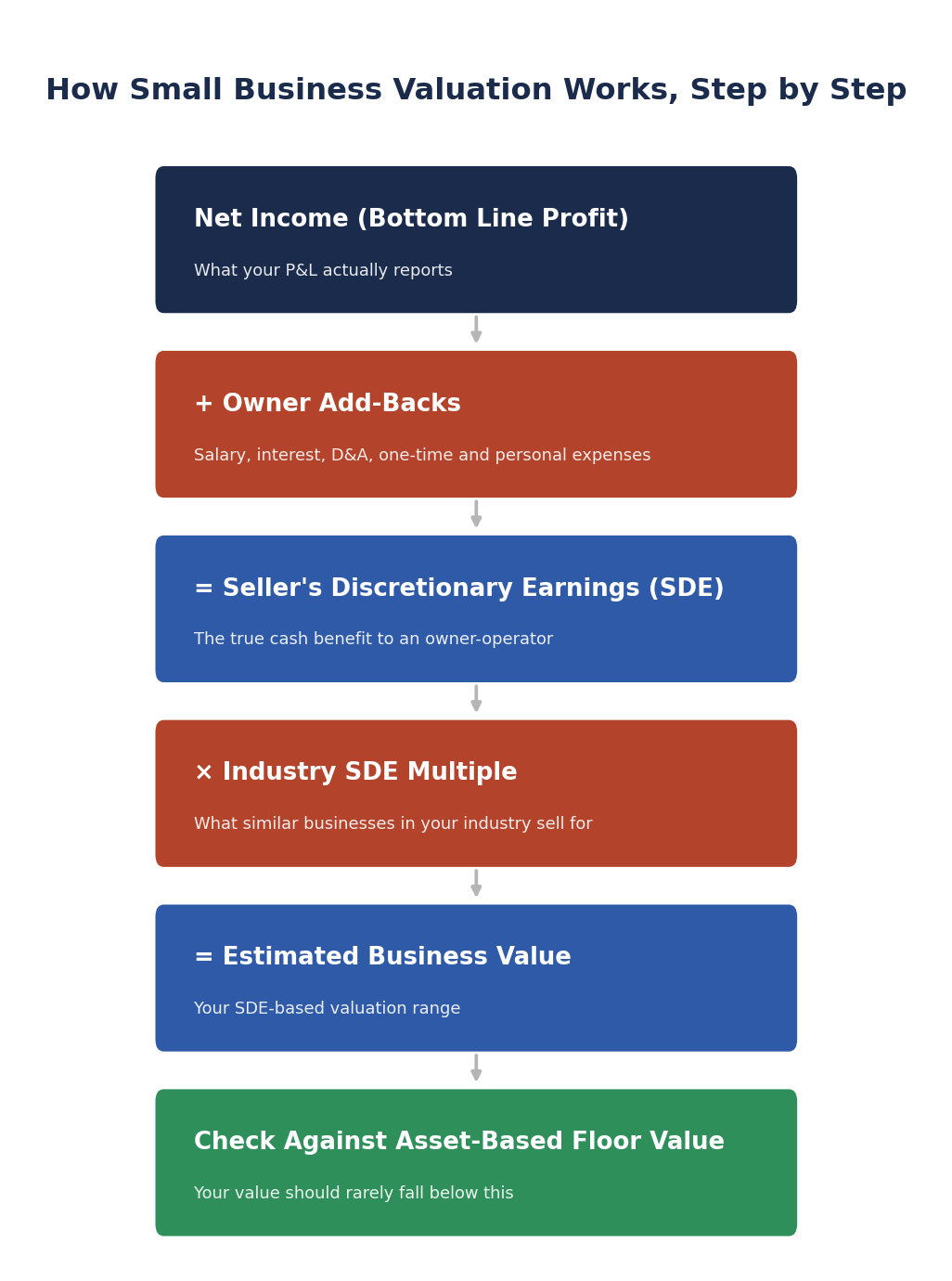
Net Income (Bottom Line Profit)
Start with what your P&L actually reports as profit — revenue minus every expense. This is your starting point, not your final answer, because a small business’s reported profit almost always understates what it’s really worth to a buyer.
Owner Add-Backs
This is the step most owners skip, and it’s the one that matters most. Add back your own salary or draw, interest expense, depreciation and amortization, and any one-time or personal expenses run through the business — a family vehicle, a one-off legal bill, a slow month’s owner bonus. These are real costs on your P&L, but they aren’t costs a new owner would necessarily keep paying in the same form.
Seller’s Discretionary Earnings (SDE)
Net income plus all of those add-backs equals your Seller’s Discretionary Earnings — the true cash benefit an owner-operator gets from the business each year, including their own compensation. SDE is the standard earnings figure used to value most small, owner-operated businesses, and it’s the number every multiple in this calculator is applied to.
Industry SDE Multiple
Similar businesses in your industry sell for some multiple of SDE — often somewhere between 2x and 4x for small owner-operated businesses, though the exact range varies a lot by industry, size, growth trend, and how dependent the business is on the owner personally. A landscaping company and a specialized software reseller with the same SDE will not carry the same multiple.
Estimated Business Value
SDE multiplied by the industry multiple gives you an estimated value — usually expressed as a range using a low and a high multiple, since no single multiple is exactly right for any individual business.
Check Against Asset-Based Floor Value
Finally, sanity-check that number against what the business’s hard assets — equipment, inventory, and other property — would be worth minus liabilities. A profitable business should be worth meaningfully more than its assets alone, but a valuation should almost never fall below this floor.
SDE vs. EBITDA: Which Should You Use?
Both are earnings measures used in valuation, but they’re built for different kinds of businesses. SDE adds back the owner’s own salary because in a small, owner-operated business, an incoming buyer is often expected to step into that role themselves — the “salary” isn’t a true ongoing cost the way it would be for a hired manager. EBITDA (earnings before interest, taxes, depreciation, and amortization) does not add back owner compensation, because it’s built for businesses professionally managed by non-owner executives, where that compensation is a real, ongoing cost regardless of who owns the company. Investopedia’s guide to Seller’s Discretionary Earnings covers how these add-backs are typically calculated in practice.
As a rule of thumb, SDE is the right measure for most businesses under a few million dollars in earnings where the owner is actively working in the business day to day. Once a business is large enough to be run entirely by hired management, EBITDA becomes the more standard measure, and multiples are calculated differently as a result.
Small Business Valuation vs. a Full P&L and Break-Even Analysis
Valuation, a profit and loss statement, and break-even analysis all use overlapping numbers but answer different questions. Your P&L tells you what actually happened — real revenue and real expenses for a given period. Break-even analysis is forward-looking and answers one narrow question: how much do you need to sell to cover costs. Valuation takes the P&L’s earnings, adjusts them into SDE, and asks a much bigger question — what is the ongoing right to that earnings stream actually worth to someone else.
In practice, a business with a healthy, well-documented P&L and a break-even point comfortably below current sales is much easier to value with confidence, because the buyer isn’t just trusting a single year’s number — they can see a track record behind it.
Common Valuation Mistakes Small Business Owners Make
A handful of errors distort a valuation more than almost anything else, and they tend to push the number in a direction that later causes problems in a real negotiation.
Valuing off revenue instead of earnings. A business with $2 million in revenue and a business with $2 million in revenue and half the profit margin are not worth the same amount, and any valuation that starts and ends with a revenue multiple alone is missing the more important number.
Forgetting to add back your own salary. If you skip the owner add-backs, your SDE — and therefore your valuation — comes out artificially low, sometimes by a significant margin. This is the single most common reason small business owners undervalue what they’ve built.
Using a multiple from an unrelated industry. Multiples vary widely by industry, and a number pulled from a generic online source without checking whether it applies to your specific type of business can be off by a full multiple point in either direction.
Ignoring liabilities entirely. A valuation based purely on SDE and a multiple describes what the ongoing earnings stream is worth — it says nothing about existing business debt, which still needs to be accounted for separately in any actual sale structure.
Treating one estimate as final. A valuation is a snapshot based on the inputs at the time — SDE, the multiple, and the asset picture. All three shift as the business changes, and a number from two years ago can be meaningfully stale today.
How to Use It
Start with your most recent full year of financials. Enter your net income, then work through each add-back honestly — the goal is your true SDE, not the highest number you can justify. Research a reasonable low and high multiple for your specific industry and business size rather than using a single generic figure, and enter both to get a range instead of one number.
Fill in your asset and liability totals to see your floor value, and your annual revenue if you want the additional revenue-multiple cross-check. The weighted summary lets you adjust how much each method counts toward your final estimate — most small, profitable service businesses should weight SDE most heavily, while asset-heavy businesses may want to weight the asset-based method more. Working through all three sections is really the fastest way to learn how to value a small business with real numbers instead of a rule of thumb.
Frequently Asked Questions
What’s a typical SDE multiple for a small business?
Most small, owner-operated businesses sell somewhere between 2x and 4x SDE, but the honest answer is “it depends heavily on your specific industry.” A business that’s highly dependent on the owner’s personal relationships and skills typically sells at the lower end, while one with documented systems, a trained team, and recurring revenue can command the higher end or beyond.
Should I value my business based on revenue or profit?
Profit-based methods — SDE or EBITDA depending on the size and structure of the business — are the standard for a reason: two businesses with identical revenue can have completely different values if their costs and margins differ. Revenue multiples are sometimes used as a quick cross-check or in specific industries with unusually consistent margins, but they shouldn’t be your primary method.
Does this calculator account for business debt?
Not directly — the SDE multiple valuation estimates the value of the earnings stream itself. The asset-based section does net out liabilities against assets to give you a floor value, but in an actual sale, outstanding business debt is typically addressed separately in how the deal is structured, not folded into the core valuation number.
How is this different from a professional business appraisal?
This calculator uses the same core method — SDE times an industry multiple — that professional appraisers and business brokers start with. A formal appraisal goes further: verifying your financials, researching comparable sales in more depth, and accounting for factors specific to your business and market. This tool gives you a credible starting range; a professional appraisal is worth the cost once real money or a real transaction is on the table.
Can I use this to value a business I’m thinking about buying?
Yes — the method works the same way from the buyer’s side. Ask the seller for the financials needed to calculate SDE, research the appropriate multiple for that industry, and use the same weighted approach to sanity-check the asking price against an independent estimate before you negotiate.
Download the Free Small Business Valuation Calculator
Download the free Small Business Valuation Calculator below — no email signup required. It’s pre-loaded with sample numbers so you can see exactly how it works before you clear it out and enter your own.
Want new templates emailed to you?
No spam. Unsubscribe anytime. Downloads never require this.
Looking for more small business finance tools? Check out our Profit and Loss Statement Template, our Break-Even Calculator, our Contribution Margin Calculator, and our Cash Flow Forecast Template. And since the asset-based floor value comes straight from your books, our Balance Sheet Template is the natural starting point.
Before you value the business, it helps to know where it’s headed. Our Financial Model Template projects 12 months of financials so you can see the numbers behind your valuation.
