
Your Profit and Loss Statement tells you what you earned this year. Your Balance Sheet tells you what you own and owe right now. But if you want to know how much of everything you’ve ever earned is still sitting inside the business — as opposed to paid out to owners — that number lives on a different document: the Statement of Retained Earnings.
It’s one of the most overlooked financial statements small business owners keep, mostly because it’s short and easy to fold into a balance sheet footnote. But it answers a question every owner eventually asks — “where did all the profit actually go?” — and it’s the number lenders and buyers check first when they want to know whether a business reinvests in itself or drains cash out as fast as it comes in.
The free Excel template below builds a five-year Statement of Retained Earnings that rolls forward automatically, so once you enter your starting balance you only ever have to add two numbers a year: net income and dividends or owner draws.
Want new templates emailed to you?
No spam. Unsubscribe anytime. Downloads never require this.
What’s Inside the Free Statement of Retained Earnings Template
The download is a single Excel file pre-loaded with five years of sample numbers for a fictional manufacturing company, so you can see exactly how the formulas behave before clearing them out and entering your own. Beginning Retained Earnings for Year 1 is the only balance you type in manually — every year after that pulls its opening balance automatically from the prior year’s ending balance, a built-in line chart shows the trend, and a year-over-year change row flags when growth is slowing.
How to Prepare a Statement of Retained Earnings, Step by Step
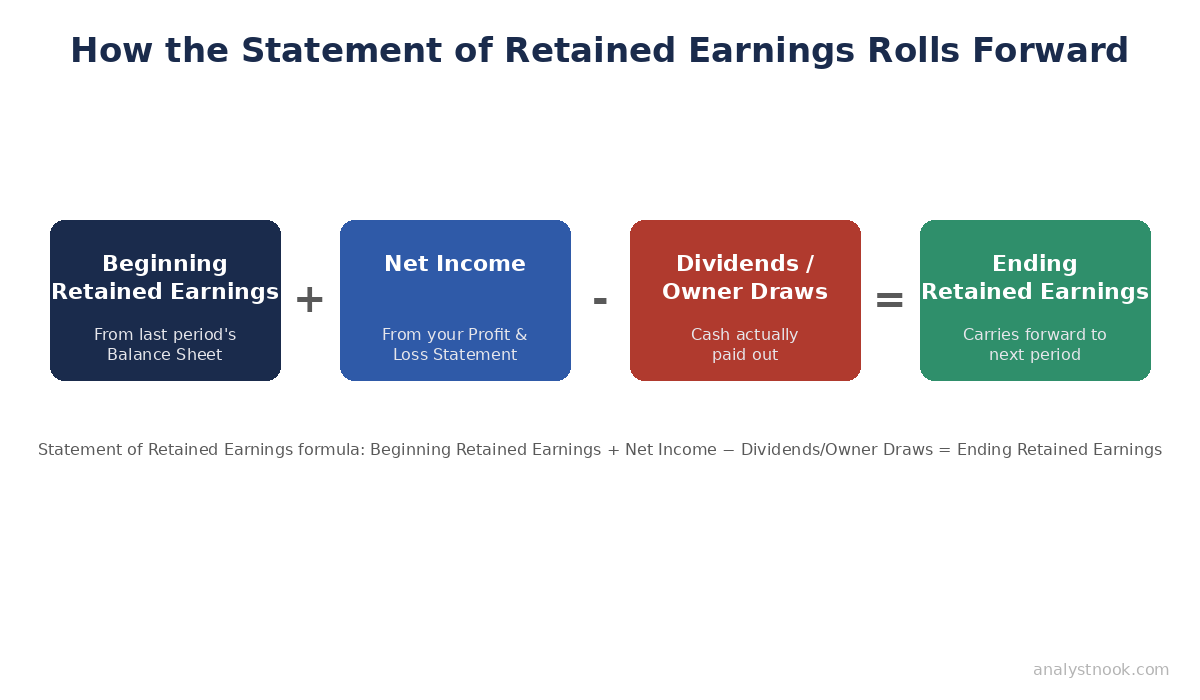
The statement itself is only four lines. Almost all of the actual work happens in the two documents that feed it.
Beginning Retained Earnings
This is last period’s Ending Retained Earnings, pulled straight from your prior Balance Sheet. If this is your business’s very first year, it starts at zero — there’s no accumulated profit yet because there’s no prior period.
Add: Net Income
Pull this directly from the bottom line of your Profit and Loss Statement for the same period. If the business lost money instead, this line is negative, and it reduces retained earnings the same way a dividend would.
Less: Dividends or Owner Draws Paid
This is cash actually distributed to owners or shareholders during the period — not cash you’ve merely decided to distribute. A dividend that’s been declared but not yet paid is a liability on the balance sheet, not a reduction here yet.
Ending Retained Earnings
Beginning Retained Earnings, plus Net Income, minus Dividends or Draws. That’s the whole formula. This number then becomes next period’s Beginning Retained Earnings, and it flows onto the equity section of your Balance Sheet, which is exactly why the two statements always have to agree with each other.
A Statement of Retained Earnings Example
Here’s what the formula looks like with real numbers. Say a small manufacturing business starts its fiscal year with $185,000 in Beginning Retained Earnings, carried over from last period’s Balance Sheet. Its Profit and Loss Statement for the year shows $64,000 in Net Income, and the owner took $20,000 in draws during the same period.
Run those three numbers through the statement of retained earnings formula: $185,000 Beginning Retained Earnings, plus $64,000 Net Income, minus $20,000 in Dividends or Draws, equals $229,000 in Ending Retained Earnings. That $229,000 becomes next year’s Beginning Retained Earnings, and it’s the figure that carries forward into the equity section of the balance sheet from here on.
Investopedia’s overview of retained earnings makes the same point: it’s one of the first numbers analysts and lenders check when they want a quick read on whether a company reinvests its profit or pays it out — exactly the pattern a running statement of retained earnings like this one is built to show.
Where Retained Earnings Fits with Your Other Financial Statements
Retained earnings is the connective tissue between your income statement and your balance sheet. Your Profit and Loss Statement measures performance over a period; your Balance Sheet measures position at a single point in time. Retained earnings is what links them — it’s the running total that carries each period’s profit (or loss) forward into the next one, sitting inside the equity section of the balance sheet.
It’s a separate question from cash. A business can have strong, growing retained earnings and still run short on cash if that profit is tied up in inventory or unpaid invoices — which is exactly what a Cash Flow Forecast is built to catch. Retained earnings tells you what the business has earned and kept; a cash flow forecast tells you whether it can actually pay its bills next month.
What a Shrinking or Negative Retained Earnings Balance Means
A steadily growing retained earnings balance is a healthy, boring sign — the business is profitable and keeping more than it pays out. A shrinking or negative balance (sometimes called an “accumulated deficit”) is worth a closer look, though it isn’t automatically a red flag. It usually comes from one of a few causes: several years of losses eating into prior profit, distributions or owner draws consistently outpacing what the business earns, or a large one-time write-off or dividend that temporarily pushed the balance negative.
Context matters here. A three-year-old startup with negative retained earnings because it’s still investing heavily in growth is a very different situation from a mature business quietly paying out more to its owner every year than it actually makes. Lenders and buyers know the difference, and they’ll ask which one they’re looking at.
Common Mistakes When Preparing a Statement of Retained Earnings
Confusing retained earnings with cash on hand. Retained earnings is an accounting balance, not a bank account — a business can show $400,000 in retained earnings and still have very little cash sitting in the bank, because that profit has been reinvested in equipment, inventory, or paying down debt.
Recording a declared dividend as if it were already paid. Until the cash actually goes out the door, a declared-but-unpaid dividend belongs on the balance sheet as a liability, not as a reduction to retained earnings yet.
Forgetting prior-period adjustments. Correcting a material error from a prior year (not just this year’s normal activity) sometimes needs to adjust the Beginning Retained Earnings balance directly rather than flowing through this year’s net income — this is a case worth a bookkeeper or accountant’s input rather than guessing.
Treating owner draws in a sole proprietorship or partnership exactly like corporate dividends. The mechanics are similar, but the equity section and tax treatment differ by entity type, so the label matters even when the arithmetic doesn’t.
How to Use It
Start by entering your actual Beginning Retained Earnings for Year 1 — pull it from last period’s balance sheet, or use zero for a brand-new business. Then add each year’s Net Income from your P&L and each year’s Dividends or Owner Draws actually paid out. Everything else — the running balance, the year-over-year change, and the chart — updates on its own. If a year comes out negative, don’t clear the formula to hide it; that’s exactly the number worth understanding before it goes further in the wrong direction.
Frequently Asked Questions
What’s the difference between retained earnings and net income?
Net income is what the business earned in a single period. Retained earnings is the cumulative total of every period’s net income, minus every dividend or draw ever paid, since the day the business started. Net income for the current year is simply the newest addition to the running retained earnings balance.
Do dividends appear on the statement of retained earnings?
Yes — dividends and owner draws are the one line that reduces retained earnings besides a net loss. They’re subtracted in the same period they’re actually paid in cash.
What does negative retained earnings mean?
It means the business has paid out or lost more, cumulatively, than it has earned since inception. It’s common in early-stage or heavily reinvesting businesses and isn’t automatically a problem, but a mature, established business with negative retained earnings is usually worth investigating further.
Is a statement of retained earnings required for a small business?
Formally, it’s most often required for corporations reporting under GAAP. Plenty of small businesses fold it into a balance sheet footnote instead of preparing it as a standalone statement. That said, tracking it separately — even informally, with a template like this one — makes it far easier to spot a trend before it becomes a problem.
How is this different from a statement of stockholders’ equity?
A statement of retained earnings covers just the retained earnings line. A statement of stockholders’ (or owners’) equity is broader — it tracks every equity account, including common stock, additional paid-in capital, and treasury stock, alongside retained earnings. Larger companies typically prepare the fuller equity statement; a standalone retained earnings statement is usually enough detail for a small business.
Download the Free Statement of Retained Earnings Template
Download the free Statement of Retained Earnings Template below — no email signup required. It’s pre-loaded with five years of sample numbers so you can see exactly how it rolls forward before clearing it out and entering your own.
Looking for more small business finance tools? Check out our Balance Sheet Template, our Profit and Loss Statement Template, and our Cash Flow Forecast Template. If you’re weighing whether to reinvest this year’s profit or take it out of the business, our guide to valuing a small business is a natural next read — retained earnings is one of the first things a buyer or appraiser looks at.
